

Ep. #185: Yoga Philosophy, Yamas & Niyamas at Work with Kimberly Kayler
Yoga is not just about what happens on the mat.
It is also about how we lead, listen, communicate, make decisions, and move through the world when no one is handing us a script.
In this episode of The Energy Fix, Tansy sits down with Kimberly Kayler for a thoughtful conversation about the intersection of yoga philosophy, leadership, communication, and modern business.
Together, they explore the yamas and niyamas, ancient yogic principles that offer a surprisingly practical framework for self-awareness, ethical decision-making, personal growth, and workplace culture.
Kimberly brings her experience in marketing, crisis communication, leadership, and yoga philosophy into a conversation that feels both grounded and deeply relevant. They talk about feedback, truthfulness, non-violence, self-discipline, surrender, and why self-awareness is often the missing piece in business strategy.
This episode also challenges the way we think about productivity, meetings, multitasking, creativity, and what it actually means to create work that feels more ethical, human, and aligned.
If you have ever wondered how spiritual principles can apply to leadership, decision-making, and everyday communication, this episode gives you a beautiful place to begin.
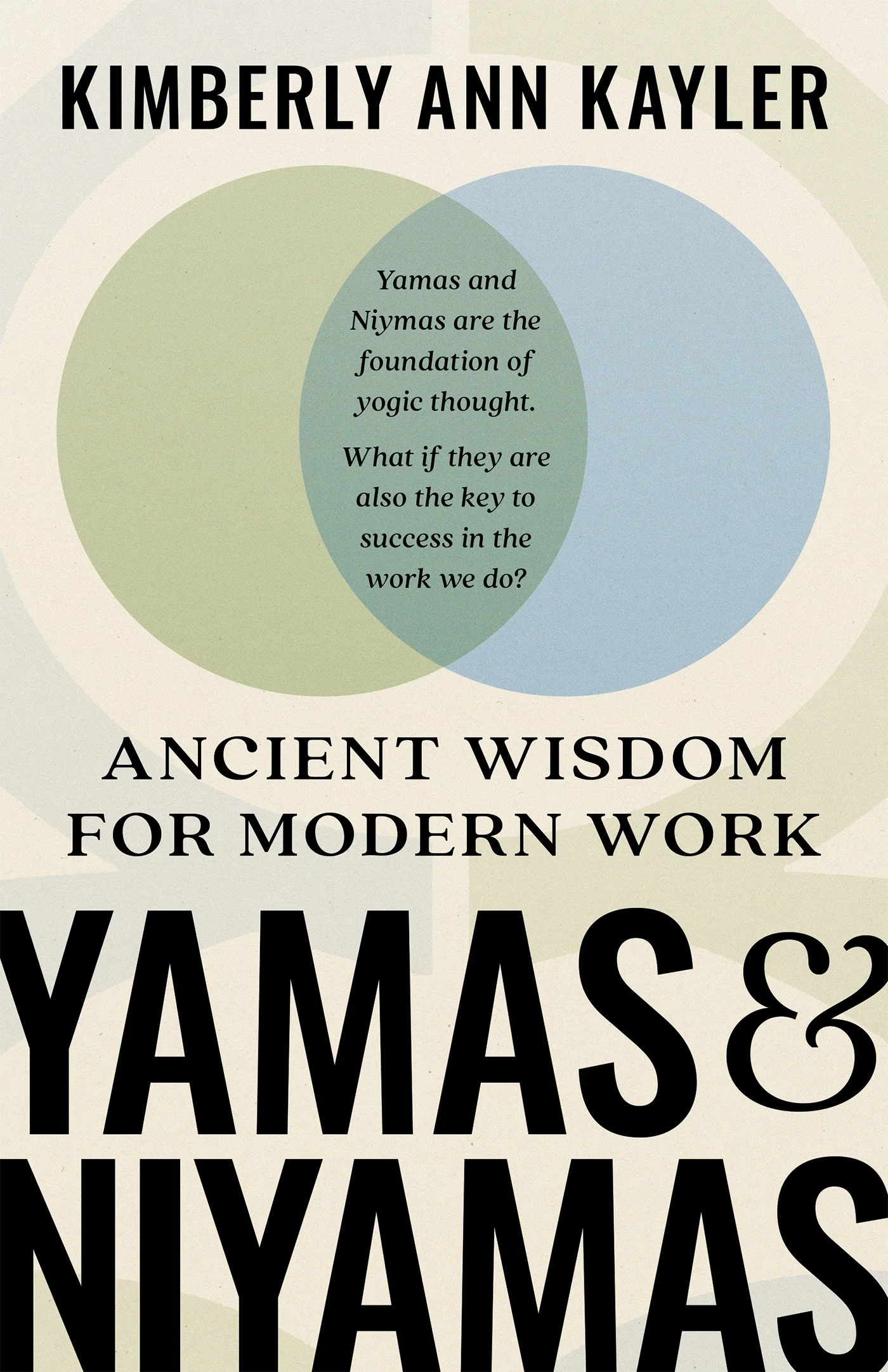
Purchase her new book!
Listen & Watch
🎙
Listen & Watch 🎙
What We Cover
In this episode, we talk about:
How yoga philosophy applies to business and leadership
What the yamas and niyamas are, and why they matter
Self-awareness as a foundation for ethical decision-making
Why organizations often overlook the inner work behind strategy
The importance of feedback in workplace growth
Non-violence as it relates to self-talk and communication
Truthfulness with compassion and clarity
Non-stealing in work, leadership, and taking credit
Non-excess and the importance of reducing clutter, multitasking, and unnecessary output
Why meetings need purpose and intention
Productive restlessness, creativity, and innovation
Creating space for wonder in workplace culture
The art of listening without making the conversation about yourself
Self-discipline, self-study, and surrender as leadership practices
Key Takeaways
Self-awareness is essential for ethical leadership and decision-making
The yamas and niyamas offer a practical framework for personal and professional growth
Non-violence includes the way we speak to ourselves and others
Truthfulness becomes more powerful when paired with compassion
Multitasking can pull us out of presence and effectiveness
Non-stealing includes not taking credit for another person’s work or ideas
Non-excess invites us to reduce clutter, overwork, and unnecessary commitments
Meetings should have a clear purpose, not exist out of habit
Creativity needs space, curiosity, and room for wonder
Listening deeply can transform relationships, teams, and workplace energy
Saying no can create more focus, integrity, and alignment
Yoga is not just a practice; it is a way of moving through the world
Favorite Quotes
A few moments you’ll want to remember:
“Yamas and niyamas provide a framework for growth.”
“Feedback is essential for growth but often neglected.”
“Non-violence extends to self-talk.”
“Truthfulness requires compassion and clarity.”
“Multitasking hinders our ability to be present.”
“Don’t have a meeting just to have a meeting.”
“Self-awareness is key.”
“What brings you joy and what’s tiring you out?”
“The world goes on when you say no.”
“Yoga is how we move through the world.”
Chapters
00:00 – Yoga Philosophy and Why It Matters Now
03:38 – Kimberly’s Journey from Corporate Marketing to Yoga
06:10 – Business, Ancient Wisdom & the Pandemic Shift
09:47 – Understanding Yamas and Niyamas
17:14 – Ahimsa: Nonviolence in Work and Life
20:09 – Satya: Truthfulness and Honest Communication
28:10 – Asteya: Attention, Presence & Non-Stealing
34:04 – Santosha: Purity, Contentment & Inner Clarity
39:41 – Tapas: Self-Discipline and Leadership Habits
48:48 – Ishvara Pranidhana: Surrender and Letting Go
01:12:33 – Applying Yamas and Niyamas in Daily Life
Why This Episode Matters
Because the way we work is also the way we practice.
It can show up as:
saying yes to meetings that do not need to happen
giving feedback without enough compassion or clarity
avoiding hard conversations because they feel uncomfortable
taking on too much because stillness feels unproductive
confusing busyness with actual impact
pushing through work while ignoring what feels draining or misaligned
Many workplaces try to solve problems with more strategy before addressing the people, energy, and awareness behind the strategy. This episode matters because Kimberly brings the conversation back to self-awareness. The yamas and niyamas remind us that leadership is not just about what we accomplish.
It is also about how we show up, listen, tell the truth, use our energy, and create space.
Ethical work is built through the choices we make in conversation, collaboration, and the everyday moments where our values either show up… or quietly disappear!
About Kimberly Kayler
Kimberly A. Kayler is a veteran entrepreneur, marketing and crisis communications expert, and co-author of Leading with Marketing. Named one of the most influential people in the concrete construction industry, she runs a consulting firm, teaches in the University of Wisconsin’s MBA program, and leads a Yoga Alliance–recognized teacher training school. She lives in Wisconsin’s Northwoods with her husband and two dogs.
Links Mentioned In The Show
Get her book, Yamas and Niyamas: Ancient Wisdom for Modern Work
Website: www.wisdomfortheworkwedo.com
Just Thrive & Just Thrive Probiotics: Save 15% off your order by clicking here!
Podcast review promo...Get 15% off a distance energy healing session or a piece of jewelry with a positive review of the show. Email photo of review (aftersubmitted on podcast platform) to info@tansyrodgers.com
Support Beyond The Episode
If this conversation hit home, and you’re craving deeper support (not just ideas, but real integration):
Join the newsletter →
If this episode made you think differently about work, leadership, or the way you show up in daily conversations, take a moment to ask:
Where could I bring more self-awareness into the way I work?
If this conversation resonated, follow or subscribe to The Energy Fix, leave a review, and share it with someone who is ready to bring more intention, awareness, and humanity into the way they lead and live.
Transcript
-
Kimberly Kayler (00:00.024)
There's five yamas, five niyamas. And let me stress that you don't ever have to do yoga to actually benefit from looking at this ancient wisdom. I will also stress that it's not a religion in any way. So you're not signing up for anything here, though they can be very religious and very spiritual, what you want to make of it. The first one is ahimsa, and that one is often translated as nonviolence. And when I was first learning about it, we tend to have concepts related quickly. Maybe your mind went to the Judeo-Christian of
Thou shalt not kill, etc. But the beautiful thing about this Yama is that it actually talks about.
Tansy Rodgers (00:36.238)
Yeah.
Tansy Rodgers (00:49.048)
Welcome back to the Energy Fix, a podcast dedicated to help you balance your energetic body by diving deep into the sweet world of all things health and spirituality. My name's Tansy, and I'm an intuitive Crystal Reiki energy healer, energetic nutrition and holistic health practitioner, and a crystal jewelry designer. It's time to talk all things energy. Let's dive in.
Welcome back to the Energy Fix Podcast. Today we're talking about yoga philosophy. But diving into the deeper teachings of yoga, we're going to specifically be talking about the yamas and the niyamas and how these ancient principles can actually shape the way that we work, the way we lead and communicate, how we make decisions, how we handle conflict and run businesses and really show up for the people around us. Because
Let's be honest. A lot of workplaces are not suffering from a lack of strategy documents. They're suffering from a lack of self-awareness and honest communication, a sustainable pace and ethical decision making, you know, that real human connection. And I couldn't be more excited to have our guest here today to speak all about this. Our guest today is Kimberly Kayler
A veteran entrepreneur, marketing, and crisis communication expert, co-author of Leading with Marketing, MBA instructor, and leader of a Yoga Alliance recognized teacher training school. Her new book is Yamas and Niyamas, Ancient Wisdom from Modern Work. And what I am going to be so excited to dive into in this conversation is things that
Are going to be expanding your mind when it comes to yoga philosophy. We're going to be talking about spiritual principles off the mat and into real life, into our meetings and our inboxes and leadership choices and feedback conversations and business culture. And yeah, we're going to be really diving into the modern perspective. All right, Kimrille.
Tansy Rodgers (03:08.878)
Let's dive in. Welcome to the show. I'm so excited to have you here today.
Kimberly Kayler (03:13.624)
Thank you. I'm excited to be here. Thank you for having me as a guest.
Tansy Rodgers (03:16.812)
Yeah, I want to really just dive straight in and let's talk about the book. What if the path to a smoother, more ethical business doesn't start with another strategy session, but with self-awareness? Can you speak on that?
Kimberly Kayler (03:38.542)
And wouldn't that be amazing? And let me say right from the beginning, when we're talking about work, I want to make sure we don't alienate those that are teachers or those that are in healthcare, you know, those that are doing volunteer work at nonprofits. we're talking about the work that we do. So however that shows up for you, not just corporate executives. So this book really dives into how to take some ancient wisdom.
and apply it and find that intersection, which is something I shied away from from a long time. So I'm hoping that's something that we can talk about that intersection.
Tansy Rodgers (04:15.712)
Yeah, yeah. And so let's talk about that. Let's talk about that intersection. I want to hear about your story. You know, you've spent years in marketing and crisis communications and business leadership, et cetera, et cetera. And now you're over on this other side of the spectrum and you're trying to merge it all together and to really teach these principles.
Let's talk about that in conjunction with what you've learned and why you feel this is so important to bring to our modern world.
Kimberly Kayler (04:47.96)
Definitely. So a little bit of context. got about 30 years in corporate marketing and crisis communications. And I found yoga about 15 years ago. And I didn't find yoga because I was searching for some spiritual awakening or to help me at my corporate job. It was because honestly, I was a burnt out marathon runner and I was told I needed to do yoga. So I had to do something different. And what I quickly learned,
Over a couple of years, was that these lessons that you learn as you become a yoga teacher, which I decided to go on to be, with regard to how you govern your own actions as well as how you respond to the rest of the world, didn't just apply to me as a yoga teacher, or didn't just apply to me on my mat when I was practicing yoga. It also I found it popping up more and more in decision making I was making in the corporate world. And that was really interesting.
a weird intersection for me because I was raised that, you know, business, you know, the separation of church and state, if you will, if we can use that phrase. you know, w you don't talk about politics, you don't look talk about religion, you don't talk about money. so the molding of these two things into one world seemed really strange to me. but as I began to realize, especially during the pandemic, and that's when I decided to write the book,
I saw how organizations needed a better compass for how they made decisions, not just based on profit, but how they made decisions with regard to their people, that it was really key to apply this ancient wisdom.
Tansy Rodgers (06:26.508)
Yeah, yeah. So Kimberly, thinking about where you were and where you're going and moving into, is there a word or a phrase that you feel that you are now stepping into in comparison to where you were to help you keep moving forward in this work, in this the way that you apply this to your own life?
Kimberly Kayler (06:45.026)
I think the word is connected and I'm not there yet, but it is something that I'm striving to, especially as I enter this next phase in my life. I'm not ready to retire yet, but it is on the horizon. So how do I bridge all of this together? and I, you know, I think that would be my hope for others as they listen to this, if they read the book, if they look at any of the other resources, is to find a connection between how we govern ourselves, how we live ourselves in one aspect of our life does transcend.
to the other things that we do.
Tansy Rodgers (07:17.494)
Yeah. And connection, I think, is the most beautiful word, not only to expand on for our own personal development, but even just how we're moving into this conversation. Because I wanna, I want to hear you, I want to hear you talk about is specifically what yamas and niyamas actually are for especially for those who have no idea what those two words mean.
mean. Let's talk about that and how that really feeds into your own personal world word of where you're at in connection.
Kimberly Kayler (07:53.218)
Definitely. So yamas and niyamas, and I've got a little cheat sheet here because they're in Sanskrit. So forgive me for like looking at them. but there's five yamas, five niyamas, and let me stress that you don't ever have to do yoga to actually benefit from looking at this ancient wisdom. I will also stress that it's not a religion in any way. So you're not signing up for anything here, though they can be very religious and very spiritual, what you want to make of it.
So the yamas, the first part we'll tackle, the first one is ahimsa. And that one is often translated as as nonviolence. And when I was first learning about it, we tend to have, you know, concepts were let quickly maybe your mind went to the Judeo-Christian of thou shalt not kill, etc. But the beautiful thing about this yama is that it actually talks about the violence that we do to ourselves.
by the things that we do, the things that we say to ourselves, the things that we, you know, take on. So that's one one of them. the second yama is satya or truthfulness. And this yama goes beyond how we should be truthful to others, but also truthful with ourselves. And I've got examples of all of these we could talk through. And there's three more yamas. And as we go into the niyamas, we are talking a little bit more
About how we govern our actions and and how we react to the world beyond us, too. you know, so that's a really key thing for us to think about as well. And that dives into strategy, it ties into burnout, et cetera. So hopefully we can kind of walk through each of them if you want, or if you want to dive in one by one, whatever would work for
Tansy Rodgers (09:35.374)
For you. I love that. Yeah. And so I I before we do that, I wanna I wanna kind of bring this back to your book. Your book frames the yamas as how we move through the world, correct? It does. And and niyamas is how we behave in the world. Yeah. So can you tell us why that distinction is so darn important and especially why it matters in the work that you do?
Kimberly Kayler (09:47.182)
Correct.
Kimberly Kayler (09:52.622)
how we behave in the world, correct?
Kimberly Kayler (10:03.822)
Came to life for me, especially during the pandemic. And that's the reason that I sat down to write the book. because I think our organizations they tend to think that they, they are caring for people and they are being ethical in their decision making. But we saw during the pandemic that for many organizations, it was the first time that they actually had to make decisions about their people. Now I know that sounds harsh. You know, organizations like that's not true. I make
Decisions about my people every day. But you don't. You make decisions about hiring and firing and how to get the work done. But this was a matter of actually having to make decisions with regard to how others govern their own actions, how the decisions you make will impact a group of people, not only your employees, but maybe your customers, maybe your clients, maybe your industry at whole.
And there was a really, and I talk in the book about this too, there was a really strange interplay for the work we do of having to balance actually keeping the lights on and keeping business going while still taking care of your people. You know, so it's not as simple as me just saying here, right, like, you know, no, people first no matter what, you know, but part of taking care of people is also making sure you can keep the lights on. And so I found the organizations that we were working with.
had tremendous decision fatigue. And I think that's where the yamas and niyamas can help us because it becomes a decision tree. It helps us actually guide through our actions and and guide our behavior and how we respond to things if we understand ourselves a little bit better.
Tansy Rodgers (11:49.49)
Yeah. Well, okay. And so let's actually dive just a little bit deeper into that self-awareness, you know, how we understand ourselves. You write about self-awareness as a thorough line in or through line in crisis communication and strategic planning and marketing and you know, leadership, et cetera. Why do you think a self-awareness is so often skipped when it comes to business or the work that we do, even though it shapes everything?
Kimberly Kayler (12:19.286)
Because self-awareness is really, really hard. It's really, really hard. It's hard to be self-aware. And then it's hard to actually put it out there and really respond to it. So, you know, if you're doing a strategic plan and I've, you know, been a strategic planning consultant for 20 plus years, so often an organization will do a strategic plan, but they haven't taken the steps to really understand who they are. And they they think they do, but
Tansy Rodgers (12:22.004)
Yes, it is.
Kimberly Kayler (12:48.504)
They, you know, really being honest of like what that the implications are and what they mean. So they create these plans that end up sitting on the shelf because they have no reality to what their team is really capable of doing or what their team is willing to do. So, you know, I like to share the example. This is a silly one, but if your strategic plan really shows that, you know, hey, the best way to maybe get your word out.
is for your team members to wear funny animal costumes and stand on a corner with signboards. and that's the best way to actually do something, great. But putting it in a plan and if you're not self-aware enough to know that that's never going to happen with my team, it doesn't matter. But we all go down these paths. We hire the consultants, we go down this path of doing that without clearly looking at, hey, that doesn't fit our culture, that doesn't fit who we are, it doesn't fit my personality.
and we convince ourselves that it will, but it usually doesn't. It usually doesn't. And we see this, you know, across the board, whether corporate executives, but our education system, the nonprofits that we volunteer and work for, we're not typically honest about where we are, what our shortcomings are, and having that self awareness.
Tansy Rodgers (14:01.644)
Yeah, that makes sense. That makes that makes complete sense. And I think too that the bigger that the organization or the bigger that the that the work is, it can make it that much harder to really be in that deep self-awareness to the level that you need to be to be able to feel like you're like you're really moving forward and doing the work.
doing the the work that you wanna work that you wanna do.
Kimberly Kayler (14:33.358)
Definitely. I think one of the things that we talk about in the yamas is with c with self-awareness is really actually also understand where you're limiting yourself. you know, for example, are you already making decisions about something, limiting yourself because you don't think you can do it? And the studies have shown that especially women applying for jobs,
Women typically will not apply for a job unless they can meet 90% of the qualifications, where where men actually have a little more confidence in most cases, and they will actually apply if they can meet 30% of the things on those lists. So having that self-awareness of, hey, maybe I do need to go for it. we limit others too. I share an example in the book, especially in a corporate setting where we think we're helping, but we're making decisions for others.
and I I shared example of when I became a a new yoga teacher. We had learned how to make adjustments on people with permission, but to help them get into a pose. And I helped someone, I asked permission and I helped adjust them in child's pose. And I was so proud of myself. And I like whispered to her, I said, Do you feel better now? And she looked up at me and she said, I didn't feel bad before. And it was like so like haunts me to this day.
That I thought I knew what was better for her in this pose because I looked at it. Now, how does that translate to the work we do? Well, we make decisions for people based on, you know, Joe isn't gonna want this promotion. He said he didn't want to travel because of his kids. Well, that was ten years ago. Have we had a discussion with Joe to see where his heart is right now? Are the kids at a different place, et cetera? So, you know.
Silly example on the yoga side, but it's really, really true. We do this all the time with people in the work that we do as well.
Tansy Rodgers (16:26.348)
Yeah. can really I've been there, done that. It's so uncomfortable. Yeah. Yeah. my gosh. Yeah, yeah. All right. Well, let's dive into the yamas and the niyamas and let's talk about let's talk about each of them individually.
Kimberly Kayler (16:35.201)
What you need.
Kimberly Kayler (16:44.878)
Okay, fantastic. So the very first one, and I'm peeking through my book is the easiest way to do it. And I teed this up a little bit, which is ahimsa or nonviolence. And again, Judeo-Christians concepts may pop up for you or maybe whatever, a different, you know, religious upbringing that you may have. But this one goes so much far beyond that. It's not knowing, knowing what is best for others, which we just talked about, that violence.
limiting harm. I have a huge section in the book just related to succession planning and what a disservice we do for people and our organizations as well, the work that we do by not planning for your departure. And I'm not just talking about being hit by the proverbial bus, but what are you doing to actually train that next generation? We have five generations in the workforce right now.
So what are what are we doing to make sure that we have that succession planning in place? We do harm by by not doing that. profit at all costs, which I talked a little bit about too, and understanding. And there's some, you know, really great research that's come out recently about really understanding your organization and how they're making decisions not just related to profit.
And we know that these younger, the younger generations, the two younger generations in the workforce value more. And I of course I'm making a a generalization here, but the research shows that they value more going beyond just the profit. what is that connection to the industry at large, to their community at large, which is really key. so sustainability fits into that as well. So
Nonviolence extends beyond harming others in a personal way, but evaluate your own practices to identify potential harm to yourself. That's where that self talk comes in too. Like, what harm are you doing by the things that you say to yourself, the narratives that you tell yourself is really, really key. So that's an himsa.
Tansy Rodgers (18:50.67)
I with with that one in particular, are there small quiet ways that you have seen that leaders or organizations can actually cause harm but not mean to do it? Like some of like some of the real quiet things that maybe just get pushed under the rug and you just don't even think about it?
Kimberly Kayler (19:12.27)
making assumptions for other people in terms of especially where they were. I, you know, think of think of the intern that's in the office. It's almost always thought of as the intern. there's a lot of harm that's done by you know, assuming that the woman that is on the task group because she's good at taking notes and she's, you know, her handwriting's better, that.
She she's the one that does that kind of thing. Like assuming roles is a really, you know, key one that we talk about as well. Succession planning is really key. Like, what are you doing to make sure? I mean, everybody's replaceable. And that comes with that self-awareness. Like we are all replaceable. You're replaceable. I'm replaceable. No matter how good you are. And we need to actually operate from a mindset that we are replaceable. What are we doing to make sure our teams are elevated to be able to take that next step?
Tansy Rodgers (20:04.094)
Yeah. interesting. Interesting. Okay. All right. Yama number two.
Kimberly Kayler (20:08.878)
Yama number two is satya or truthfulness. So the interesting thing about this one, and by the way, Ahimsa is like the granddaddy of them all. Like you don't, you know, if they have a hierarchy, that's that's the big granddaddy. except when it comes to satya, so truthfulness is that we feel yeah, like we should be telling the truth, but then you ask yourself, well, then how does that interplay with
Tansy Rodgers (20:29.932)
Like a really big one. Yeah.
Kimberly Kayler (20:37.4)
Telling the truth causing harm. You know, and I'm thinking about like, you know, what our moms may have said to us of like, you know, don't if you don't have anything nice to say, don't say it at all. but the Satya digs back a little bit and talks about not just being nice, being being real. And we live in a society where we're often nice, but are we actually real?
there's a book I'm reading right now. I can't remember the name of it. It's really awesome. I'll have to get it to you. But it goes beyond being nice to actually being kind. Like, like sit with that and think about the difference of that. Like, are you just being nice or are you truly being kind? And what is the role that truthfulness plays into that? One of the key areas here is actually feedback. And I am a junkie on this topic. we don't do a good job in the work we do.
today in actually providing feedback to our employees to our other team members. Why? Because it's hard. It requires that self-awareness. It requires difficult conversations, which most of us are not equipped or trained to do and we shy away from it. So a key area of this this Yama is actually really looking at and peeling back, am I giving feedback? And I'm not talking about quarterly or yearly reviews that you do with employees.
Are you truly giving feedback? You're doing harm if you're actually not giving person feedback so that they can grow and they adjust. So there's some tips and and just how to actually structure those conversations. There's a great book called Radical Candor that I highly recommend that really helped me learn how to give feedback. It's something that's really, really key. And then encouraging others to speak their truth is really key too.
Tansy Rodgers (22:25.964)
Yeah. So one thing that I have found in different organizations that I've worked in is that sometimes when people say, Listen, I'm just telling the truth, but it just it actually feels like it's a passive aggressive passive aggressive harsh way of saying it. So I would love for you to talk on that.
Kimberly Kayler (22:38.467)
Yeah.
Tansy Rodgers (22:48.98)
How can we tell the truth in a way that is more compassionate and useful and not just massed harshness?
Kimberly Kayler (22:59.512)
So part of that is in the delivery, as you can well imagine, you know, and really structuring what that what the goal of a conversation is. So it's a looks a lot different to just giving feedback of I'm just telling the truth, you know, this was bad, versus, you know, the goal of this meeting is to talk through this project. First of all, giving praise where praise is due, in a very sincere and honest way, not just placating.
And then talking about where things maybe weren't so good, but then you need to have an end game out of it, not just you know, slap somebody's hand. But okay, here collectively, as your leader, as your manager, as your team member, this is where the path forward is. So that's where the truthfulness comes in, is this is where the path forward where we're gonna work together so people understand from the feedback what to come of it. Otherwise it's criticism. It's not feedback. Yeah. You know? So
That would be something that's really key. And that that that takes practice. You know, you can hear me saying those things and it you you gotta practice it to be able to actually deliver those conversations. It's a skill.
Tansy Rodgers (24:12.686)
Break because I want to share something I make that's meant to support you in real life, not just look cute on your wrist. I create intentional crystal jewelry through BEU crystals. These pieces aren't random. I design them using crystal energy, and I also weave in numerology and geometry, and I infuse the pieces with Reiki Healing Energy as part of my process to really help support you on an energetic, deep level.
They're like little wearable anchors, the kind you can touch when you're overwhelmed, when you're heading into a hard conversation, or when you need a reminder to come back to yourself more solid, more grounded, more authentic.
I'm not here to tell you that jewelry fixes everything, but I am here to tell you that having a steady physical cue can change your day, especially if you're sensitive, easily overstimulated, or your brain likes to sprint way ahead of you. If you want to browse what's available or see what is newly released, head on over to BEUCrystals.com. I'll link it down in the show notes so that you can easily shop and check out what is available. And as
As always, if you have any questions or you want to do any custom work, you can easily reach out to me right there. Okay, let's jump back into this episode.
Yeah, yeah. And so you also talked about the feedback piece of it. Mm-hmm. Why do you think, but maybe also what have you witnessed of withholding feedback actually becoming a harm for somebody? Kind of going back into that first concept when we're not truthful, we're not giving the feedback, it can actually be a harmful concern.
Kimberly Kayler (26:05.294)
So I think where that comes in is actually asking yourself, does this person actually need this piece of information? You know, I'm I what keeps popping into my head, and I apologize for this, but you know, movies and somebody found out something about, you know, somebody's wife or whatever, and do I need to tell them? Like, like, do is this information that is actually going to be helpful and useful? So it goes back to that framing up that conversation, like what is the point of this conversation?
Tansy Rodgers (26:13.43)
Hmm.
Kimberly Kayler (26:34.678)
And and do it. And it's it's a little gray. It's a little gray and it's a little muddy sometimes. Like, you know, sometimes maybe the truth hurts, but it actually is something that's needed for that person or for the bigger cause. but trying to look at those decisions then through this lens, not just going right in, because then it can be gossipy, it can be critical, you know. it won't be perfect, but I think if you've actually
thought it through from this lens, it can actually help guide those conversations and the decision making. So get back to decision making, where again, we're tired of making decisions. We have decision-making fatigue. So how can this help guide your process?
Tansy Rodgers (27:17.346)
Yeah. And you know, as you're talking, I can't help to not think about how all the feedback and these conversations really help somebody evolve spiritually too. It's not just about the work that we're doing, even though that's the conversation we're having. It's not just that. It is about the spiritual and and human evolution of that individual in their life.
Kimberly Kayler (27:45.102)
That's a really, really good point. And when I'm talking about the work we do, I want us to think about like your connection to it, to your passion. So you're right. What is guiding you? Why are you showing up for this project? Why are you volunteering at the food shelf? Why are you doing these things? And then having that connection is really key. So thank you for bringing that layer on because I think it's important.
Tansy Rodgers (28:06.316)
Yeah, yeah. All right. Yama number three.
Kimberly Kayler (28:10.946)
So number three is a stay at or non-stealing. So this one talks a lot about you know, not stealing the opportunity, not not you know, limiting yourself, but then also quite a bit of discussion related to paying attention and multitasking. And we all know that we're pretty terrible at that right now. We all multitask all the time.
And there's a there's a multitasking exercise that I do. and I I find it really fascinating. The first time I did it at a mindfulness conference, I put my pen down when I did this exercise and I was so happy, you know, and the facilitator announced, you know, I was a really great multitasker. So, you know, I thought I'd won the prize. And he's like, No, no, no, that's not good. It means you've trained your brain that your brain always has to have all these inputs.
Always and you're not really paying attention to what you're doing. I know the statistic keeps changing, but it's something like our brain is thinking of other things we're doing 63% of the time. I think is the latest one I saw of what we're doing, you know. So what are we doing? We're training our brain that they need these constant inputs, that we're not actually paying attention to what we're doing. I think we see this all the time now, of not paying attention in the work that we do.
in the relationships that we have? Are we being connected? you know, from a spiritual stance standpoint, are you actually connected and really being meditative when you're trying to connect with your higher power, whatever that looks like too? Or are you going through the motions? Are you crossing something off the list? So this one talks quite a bit about that, you know, zoom fatigue where we are. And then also like
Giving credit where credit is due and delegation, not stealing opportunities from others, and is another really key part of it. so that is what Astea, the basic tenets are there. And there's so much we can talk about, you know, from a work standpoint here, of just understanding our limits, being connected to what we do, being present in a meeting that you're actually in. we're all guilty of it. I this
Kimberly Kayler (30:36.948)
This one actually came to life for me. I tell the story in the book of I was on a Zoom call at one point, and it was before the pandemic, so we weren't on cameras yet or anything like that. And my son had come home from school and he knocked on my office door and he came in. I'm like, Yeah, come on in, I'm in a meeting. And I was playing on my phone. And he actually asked me, he's like, Aren't you leading that meeting? And I'm like, Yeah. And he's like, shouldn't you be paying attention? And like
It totally caught me because I was like, Yeah, you're right. Like, and I it it wasn't that I wasn't paying attention to my team. It's just that my brain was expecting five other inputs at the same time. So, you know, if you can't sit and watch a TV show at night without your phone and scrolling, you know, you've trained your brain, you need these other inputs. So that's a key component of what this one looks like.
Tansy Rodgers (31:28.064)
Yeah. my gosh. I remember when I was working in one of my old careers and I had a coworker who he was talking about his two teenage daughters and how he was teaching them multitasking and he was teaching them how to do more things and be more efficient. And he said, you know, when you're brushing your teeth, you can also be doing this while you're in the bathroom. And I'm like,
Don't teach them this. Why? No, no, no. Especially us women, because I feel that our brains can so much easier multitask and really really pull us out of that presence.
Kimberly Kayler (32:14.84)
So that has actually been proven by neuroscientists that women actually multitask better. But again, that's not something to be celebrated. So men do not be offended by that research. the fact that maybe you don't multitask as well is actually a good thing. My guess is we were programmed that way just because of being mothers, probably, you know, but the multitasking thing. But it's not to be celebrated because it's hard on our brain, we're distracted.
you were never fully in the thing that we're doing. and then it makes it a little harder to to find your passion, your spiritual connection, et cetera, if you're always all over the place, you know.
Tansy Rodgers (32:56.696)
Yeah, yeah. I love how you're taking this and expanding it out of the obvious, but I also want to bring up something because you talk about this with your book. You write about stealing from your own success, not taking credit, not speaking up. How do you how have you found this especially show up for women in the professional spaces?
Kimberly Kayler (33:20.45)
Yeah, women tend to share, and again, I'm making generalizations here, but it's been my experience and again research has shown it, they tend to actually share the glory pretty well, which is a wonderful, admirable trait. But it does mean often that you don't get to take the credit for the things that were due or the credit doesn't come your way. So not being shy about making sure that you do make sure that that
Everybody understands that you were part of something. That's great. And I think we all have a responsibility to help others actually do that because it can be hard to do.
Tansy Rodgers (33:58.87)
Yeah. Yeah. All right. Let's move on to the next one.
Kimberly Kayler (34:04.312)
So the next one, a little harder to pronounce, it's brakmacharya and it means non-excess. So this one I dive into actually looking at our stuff, if you will. you know, we learned a lot of lessons during the pandemic about what we really needed in terms of clothing, stuff, being at the office, not being in the office, all of that. I think many of us have gone back to our old ways, but
Hopefully some of us can remember that, you know, you really only needed three shirts. one of one of the guys that I work with, he did a really interesting experiment during COVID, which I loved. He took all the t-shirts that he had and he wore a new one each day to get through the pandemic. And he said that was eye-opening to him because he actually saw all the stuff that he had and then he didn't need it. Like afterwards, he was able to actually clean it out.
so this is a matter of looking at what your stuff is. I also talk about the importance of being restless. So we're so often going to the very next thing, crossing things off our list. But being restless, like it, you know, have you stopped? Have you like we've lost the art of brainstorming? That doesn't happen very much anymore. Brainstorming is quickly then into the to-do list. Have we sat with our ideas?
I talk also about have you tried calling is the the subtitle for a section of it. and I find this with my own team, we're so dependent on the emails, and that's what I'm referring to as the excess, the the emails and that form of communication. you know, you're not getting a response. Have you actually picked up the phone and tried to talk to the client recently? And the answer's usually no. You know, so that's another key reminder of some simple things that you can do.
And then I have a whole section about rethinking email and meetings. And this is a bit of a recurring theme. It pops up in like three different places in the book. but you know, what we have too much email, we have too many meetings. we've spent a lot of time at my organization really trying to discern, as crazy as it sounds, what should be an email, what should be a team's message, what should be a phone call, what should be a meeting.
Kimberly Kayler (36:31.746)
Like, and it's actually really, really helped communication, the excess of things that come through. as silly as it sounds, we have a rule about not replying you're welcome to when you somebody says a thank you in an email, especially if it's reply to awe. And it feels mean and weird not to do it, but all of a sudden you've just like added up another thing that comes in.
so Cal Newport studies this quite a bit. He's my guru in all things here. I mean, we could talk for hours I would on on an excess of email and what that looks like, you know.
Tansy Rodgers (37:10.412)
My gosh, I feel so called out right now. there's there's so many things that I have to comment on this. First off, first off, I love this topic in in particular. And I'm not even gonna try to pronounce that that yama because I don't know that I will be able to. However, however, this is really that concept of clearing clutter, clearing mind, and keeping keeping that that attention of yours not.
Kimberly Kayler (37:32.642)
Yep, yeah.
Tansy Rodgers (37:39.998)
diverted out into so many different tentacles. Right? Yeah. and so
As you were talking, one thing that popped into my head, and I'm curious if you had any insight or any kind of of findings that you've noticed through your studies, is if we're talking about neurodivergent brains, ADHD, neurodivergent in general.
Tansy Rodgers (38:12.822)
Those individuals tend to fall into overwhelm, excess, collecting and really spreading themselves a little too thin, burnout, busyness, and et cetera, et cetera. Do you have any insight there for those? And before I ask the question, let me also say I know there's a lot of leaders out there, a lot of visionaries who are neurodivergent. And so I would love to if you have any insight about.
Kimberly Kayler (38:37.389)
Sure. Yeah.
Tansy Rodgers (38:42.306)
those individuals and how they can really work with this concept because that can be a real struggle.
Kimberly Kayler (38:49.848)
So I do not have any expertise and have not studied how this applies to neurodivergent workers and leaders, but what I can comment on, and I think it's probably pretty universal, is just the importance of saying no and building out time, you know, and that sounds obvious, but building out the time, as silly as it sounds like, building out the time for work.
building out the time for workouts. Like I actually schedule my workouts in the calendar. I schedule focus time on the calendar. And I have read that that actually is very effective for all populations. so I think that that would probably be a very good wise step that everybody could take away. you know, have you shut off your email and announce to your team that
for this hour and a half, this is what I'm doing. And I do counsel my team members when they are overwhelmed, to do exactly that thing. You know, it can be really, really helpful.
Tansy Rodgers (39:52.718)
Honestly, Kimberly, I think you just nailed it because two things that you just said. Number one, schedule it out. It needs to be in sight. It needs to be on the calendar. But also then number two, turning off notifications, turning off all those distractions that are coming in around. Yeah. Yeah.
Kimberly Kayler (40:09.024)
Another thing that I did with regard to this one and non-excess is and it it came to me because I was on vacation a couple of years ago in Hawaii, and because of the time change when I woke up, my team members on the East Coast had been working for hours and the emails that came in, I'd have a hundred emails, hundred and fifty emails waiting for me. And it became readily apparent that I needed to help with the excess of that. so that resulted
kind of serendipitously and me picking up Cal Newport's book about kind of getting rid of email, which is fascinating. But it also helped me set some norms as I came back. And this is where the spiritual journey will tie into it, is I was checking my email first thing in the morning, which immediately puts us into that adrenaline rush and that overload. And so I made myself a rule that I do not check my email now until the morning until I've meditated. And so whatever that means to any of you, whatever it
That would whatever your calling is your practice. maybe it's a walk, maybe it is true meditation, sitting down or whatever. and then I do something for my brain. I do a Duolingo French lesson just to turn my brain on. So it's a little bit of a task list. And then I move my body. I yoga, I do yoga for 20 to 30 minutes before I check my email. And that has been a game changer in my stress level.
It's trained some of my team a little bit too. When, you know, you train people about how responsive you can be. And I'm known for being responsive. So all of that plays into it too. You know, I don't know if any of that resonates with you.
Tansy Rodgers (41:51.538)
It resonates a lot. A lot. But I will say, I will say when it comes to checking emails, it's gotten to the point where I might gaze just to see if there's anything that really needs to be addressed. But other than that, I don't answer emails typically, typically. I don't answer emails until I'm done at the end of the day. And that's like one of my last things that I do. Because, because it's exactly that I know my emails will.
Absolutely take me off track. I will spend too much time on them. And then I'm not gonna get the important stuff done that needs to be done.
Kimberly Kayler (42:26.614)
I think that is fantastic. I have not got to that level yet. but I lo I love that. I love that you've, you know, compartmentalized them in a way. Yeah. And what the world doesn't end, does it? Like it's okay. You've retrained people and it comes and it's fine.
Tansy Rodgers (42:42.306)
Yeah. Yeah. Now, with that being said, if something has to be addressed, of course then I then I will. But yeah, mo most stuff can wait a few hours.
Kimberly Kayler (42:51.234)
And some organizations are experimenting with, you know, no meeting Fridays. there's a couple of Fortune 100 companies I have friends that work for, and they have rules with regard to like if it's a 20, if it's a 30 minute meeting, you have to end it 25 minutes after the hour. If it's a 60, you have to end it 50. Just so their team members have a chance to go to the bathroom and get a glass of water or check their email real quick.
Tansy Rodgers (43:17.922)
Love that.
Kimberly Kayler (43:18.59)
Yeah, because otherwise so many, depending on, you know, what kind of culture that you're in and the work that you do, you can be back to back to back to back meetings. And it's tough, you know. That's set a drownlin rush asks so what do we end up doing? We end up multitasking. We're in the meeting or we're responding to emails because we don't have time to otherwise.
Tansy Rodgers (43:36.05)
Yeah. Yeah. What have you with with that concept? like you mentioned no meeting Fridays, shorter meetings, etc. What are the simplest shifts that you've seen make the biggest difference in workplace energy? Has there been specific ones that you've seen?
Kimberly Kayler (43:56.152)
Definitely making sure if you have a meeting, you know what the purpose of the meeting is. get rid of I know that sounds obvious, but think of think of the meetings you go to. don't have a meeting just to have a meeting. Also, get rid of meetings where you go over to do lists. Nobody wants to hear anybody else's to-do list. You know? So, you know, meetings should be strategic. They should have a purpose.
Tansy Rodgers (44:01.23)
Yes.
Kimberly Kayler (44:25.758)
y you know, if you're working in a project at hand and you need status updates and you need to pull other people in, sure, that's one thing. But this whole paradigm of us all getting on a call to go over my to do list for the week and then I hear your to do list for the week, it's not effective. It doesn't do anything.
Tansy Rodgers (44:43.468)
Yeah. I I have one more question for this Yama. And and we we talk a lot about nervous system regulation here on the energy fix and we talk a lot about burnout and busyness. So this one feels like a really important one. but the question that I have is on something that you said earlier, you talked about the restlessness. And so that concept of productive restlessness, what does that actually look like from your standpoint? And
Why do we really need that room for again from your perspective? Why do we really need that room to think and dream and wonder, other than the obvious of like it's just so soul expanding? But I wanna know from your perspective.
Kimberly Kayler (45:24.088)
So this is one that I'm working on because I'm terrible at it. but it's so very, very important. you know, and it it it came to life for me a couple of years ago when I'd approached the chairman of my board and said, Hey, we're knocking it out of the park with our strategic plan. Like, what's next? You know, give me the next thing. And he said, Why don't you just sit with it for a little bit? Why don't you just be restless for a little bit? And it kind of knocked me off kilter, you know, like what? But
stopping and pausing and allowing the wonder to happen. we actually use a an assessment style called the working genius, which subscribes to not a personality style in terms of what you're good at doing, your strengths or weaknesses, you know, strengths finders, Myers, Briggs, et cetera. It actually looks at the work and what brings you joy and actually what tires you out.
and I really love that model. It's called the Working Genius because it helps you, you know, you can be really good at things that suck the life out of you. You know, you really can't. I'm known for getting things done, but the the the 80 to 100% phase, that phase sucks the life out of me. I'm a creator. And that part is so hard for me. So back to what this looks like. Sitting in wonder is not something that I'm good at. I'm good at
Galvanizing the troops. I'm good at discernment. I'm good at getting things done. I need to play in that wonder a little bit more. We all do. that's again where we, you know, connect to what our path is, you know. We should like for the most part, or at least feel some connection to the work we're doing. Of course, it's job, you know, you know, it's not perfect. You don't love everything you do, but that's where the connection to our souls actually come into it too.
Tansy Rodgers (47:16.417)
Yeah.
Kimberly Kayler (47:17.144)
I hope I answered your question. I love your insights on it.
Tansy Rodgers (47:20.242)
No, it did. You know, we had a local business. It was a it was a marketing creative company where they actually had a room designed and built that encouraged the employees to go in there and just sit and put their feet up. There were it was a creative room. There was lots of inspiration and color and things for them to do. They could take their notepad in, they could just sit and create or just be.
They could sit and meditate if they wanted to, but it was any way to just let their brain come into that peaceful state. And you know, you don't have to work at a if you're inspired by that, if you're a creative and you're inspired by that, go and tell your company to maybe have something like that, right? But you don't have to work for a company that does that. You could create that at home as well. I think that any time you can bring that into your day is such a valuable gift that you give not only to your work.
But also like I said earlier, to your soul expansion.
Kimberly Kayler (48:22.2)
Definitely. And I I like what you said about, you know, maybe it fits into a room and a work, but also then understanding where do you find that connection with yourself? So for me, you know, where I find that wonder and that creativity is actually on a run. That's what's meditative. That's where I connect to my true self. you know, it's exercise isn't the answer for everybody. It's how my brain works. So finding and understanding that, yeah, maybe sitting in a in a
cool funky room with blocks is gonna do it for you. It wouldn't for me. I'd probably be stressed out. But you know, but but so what is gonna connect to your soul, as you said, is key. And not prescribing it for others, you know?
Tansy Rodgers (49:04.544)
Yeah. All right. Let's go into the last Yama.
Kimberly Kayler (49:08.526)
So apricaria, so non-possessiveness. So this one can be summed up with what we should stop doing. And especially in the work we do, we tend to just add more and more to our plate. And I spent a lot of time talking here about the looking at the sacred cows. So think of maybe.
Tansy Rodgers (49:21.4)
Okay.
Kimberly Kayler (49:32.226)
Think of the reports that you do that made really, really good sense at one time because a client wanted them or needed them. But have you actually looked at them in the last couple of years and said, do we still need to be doing these? And that's uncomfortable to ask those questions because you've got people that are doing them and it's part of their jobs and all that. So again, props to my former chairman of the board. When we did anything strategic, he would actually ask and you know, end meetings was what are we going to stop doing? So really looking at that.
And then the other big one is the art of listening and not predetermining. and this one also ties a little bit with non-stealing. The art of a conversation without one upping. And by that I mean, you know, somebody tells you, Hey, I just got back from Hawaii on a vacation. Well, what's our normal response? We go, I loved Hawaii. Did you go here? Did that? And all of a sudden,
Tansy Rodgers (50:14.082)
Having
Kimberly Kayler (50:29.846)
them sharing their experience has turned into you sharing their experience. And that's a normal saying. That's part of how we converse. But how beautiful is it if you could just start asking them questions about their trip without interjecting your own. And so that's something I've really been working on. And I've noticed that it really enriches conversations. I mean, it's a little weird if you don't mention, yeah, we went. I mean, there's a there's a fine line to it.
But like that's something you could really practice with. because we all know it, you know, you you get anything out of your mouth, you're excited to tell something, and all of a sudden somebody comes in and it's their story then.
Tansy Rodgers (51:09.506)
Yeah.
You know, I feel like this is a really good one though, too, not even just for organizations or the work that you do, but even for everyday situations in life and clearing away the things that we don't need to do anymore so that we can then also be better in the work that we're doing, the mission that we are creating, the purpose that we're trying to step forward with. It's
You know, also clearing out the life in the back end, that foundation of yourself too.
Kimberly Kayler (51:44.716)
I think that self tying it back to self awareness then too. Yeah. Yeah. Why do I need to be doing this? What is the reason for this? How does this connect with who I am and the others around me is a really key thing too. So some of the questions that we ask at the end is like what baggage am I carrying around that I'd love to shed? Where's their clutter in my life from a mental standpoint? What should I stop doing because it weighs me down? This is a really important one. I I've noticed I think as we get older, especially as women.
I I can't speak from the male experience. I'm not sure if it's the same. But you know, I'll hear 20-year-olds say, I'm going to meet these friends. I don't really like them. You know, and then in the 30s, you do a little bit. By the time you're 40 or 50, you're like, you don't hang out with people you don't like. It just you gain a wisdom of like, my time is valuable. And when the 25-year-old says it to you, you're like, So what you went to college together. If you don't like her, why are you spending time with her?
You know, so like having that wisdom in terms of like the baggage you can let go, of letting people on their way too. I don't know if you have any thoughts on that one.
Tansy Rodgers (52:52.242)
yeah, yeah. It's interesting how just over the course of the last 10 years or so, I'm 48. So just over the course of the last 10 years or so, I'm like, I don't hang out with anybody that I used to hang out with. That's not true. I don't hang out with a lot of people that I don't hang out with anymore because I I'm in agreement with that. I have found who I have evolved to be at this point in my life, and I want to surround myself with people that truly.
Truly help to nourish that part of my soul that make me feel good. They may not be into everything that I'm into and they don't have to be. It's just about the energy that they create in my life and how that helps to nourish me on whatever level that it is. I just don't have time for just going out and hanging out with whoever, and especially if it makes me feel not so great afterwards.
Kimberly Kayler (53:47.64)
So, Tansy, it's really interesting you mentioned that because we I think we evolved to understand that on a personal level. But how does that then intersect and play and connect with the work that we do? I mean, yeah, you're gonna have to work with some people that you don't like. It's just it's the nature of work. But how can we then protect our energy related to that? not get so sucked up in those things, not own those feelings. Again, easier said than done, but I think that this.
Yama explores that a lot.
Tansy Rodgers (54:19.482)
And it also goes back to that whole concept, like you just said earlier about self-awareness. Yeah. Yeah. Yeah. Yeah. Mm.
Tansy Rodgers (54:30.616)
So we got the yamas. Now were there niyamas as well?
Kimberly Kayler (54:34.956)
Yeah, there are niyamas. So there's five of those. And Niyamas are how we behave in the world. So the yamas were governing our actions. Niyamas are how to behave. And the first one is Satya, which is purity, cleansing our bodies, our attitudes, and our actions. so this one is a little little takes a little bit to unpack and uncover how this actually shows up, especially in the work we do. But
I think it really dies into that self-awareness, reflective practices are real, mentor mental clarity, and then, you know, something that that you spend a lot of time working with is burnout is real. So that, you know, the topics and conversations that you've had and the space you've held is really key. So mental clarity, physical and environmental cleanliness, ethical conduct and integrity fit in here too.
Kimberly Kayler (55:36.18)
Yeah, those are the those are the key actions related to Satya.
Tansy Rodgers (55:40.462)
A quick pause for a gut check because gut health is not just about digestion. When your gut is supported, it can impact so many big picture things like immunity and brain support, mood and energy, and even how steady your nervous system feels day to day. And when your gut is struggling, it can show up as more than bloating or bathroom drama.
It can look like feeling run down and more reactive or foggy or anxious or like you're just not bouncing back the way that you used to. And that's why I'm a big believer in supporting the microbiome as part of a real life wellness foundation, especially if you're under stress, if you're in a busy season of your life, or your system is already sensitive. One of my consistent staples is just thrive probiotics.
I love it because it's simple, it's consistent, and it helps me feel like I'm supporting my body's baseline without turning my routine upside down. Because here's the reality. When you're supporting your gut, you're often supporting everything downstream, like your immune functioning, your nervous system resilience, and how well your body and your brain can actually do their jobs.
If you want to try it out, you can use code TANSY15 for 15% off your entire order. Jump down into the show notes, click the link, and make sure to use Tansy15 for that 15% off. All right, let's get back into this episode. Which I find so interesting because I feel like so many of those that you just said out of that first Niyama are things that many people either struggle with.
Or they feel like they it they feel like it eludes them. Mm-hmm. Mm-hmm. Yeah, that's so interesting.
Kimberly Kayler (57:36.098)
Yeah, and this one often is explained as a way to cleanse our bodies, our attitudes, and our actions. So I'm reminded too, just with regard to the role that our mind plays in things, and the conversations we have with ourselves. You know, if you so finding some clarity, if you're going into a meeting or if you're going into Thanksgiving dinner.
And you've already identified what Uncle Fred is gonna say and how Mary's gonna react and like conversations already played out in your head and you're already upset about it. And that applies to the work we do too. I'm gonna go to this committee meeting. This is gonna happen. So we're pre-programming our brains to have this anxiety, et cetera. of course it's key to have some self-awareness about things and situations, but creating some sort of clarity, creating some sort of cleansing around that is really key too.
Tansy Rodgers (58:32.174)
Yeah. All right, let's go into Niyama number two.
Kimberly Kayler (58:37.496)
So yummy number two is Santosha or contentment. And I started out by saying that the Norwegians have a saying best summarized is there's no such thing as bad weather, just bad clothing. and I do remind myself of that because I live in the very northwestwoods of Wisconsin by choice. We like winter. but you know, finding contentment in what we do, finding contentment in the form of mindfulness, practicing self-care. And I talk a lot in
this chapter about the role mindfulness plays and understanding how it can actually intersect with the work that we do. You know, so going beyond the multitasking and being burnt out, but are you connected to the work that you do? Do you believe in what you're doing? what you know, finding a connection and then some tips in terms of just like how to be more mindful for how you show up. So are you rushing into the meeting?
Could you walk a different way to that conference room and look outside? Like we have to know what, what works for all of us. Again, for me, it may be going for a run or meditating. For someone else, it may mean coloring for a few minutes, but what can you do to help set yourself up to be mindful in terms of how you approach things, how you react to others?
Tansy Rodgers (59:58.806)
Mm-hmm. And I'm really seeing here how things connect from the Yama to the Niyama. Mm-hmm. When we talked about the one that I'm not going to try to pronounce, the one about busyness. Yeah. Yeah. That was number th number three, I believe. Yeah. So when we talked about that one, if somebody is so stuck in that place of being busy or being
overactive or or or not feeling like they or if they're multitasking and doing all of these things, how that directly can play into this niyama of contentment and connectedness to the actual work that they're doing. Cause if they're running all over the place and they're running into meetings, it makes it really hard to stay connected and contented.
Kimberly Kayler (01:00:43.468)
Definitely. Or even be self-aware. So I probably should have mentioned in the beginning like where the Yamas and Niyamas came from. they were actually codified by someone by the name of Patanjali, thought to be 200 year, 200 AD or so. and the we study them when we become yoga teachers.
And when you learn them at first, it's like we're having this discussion today and you apply them a lot in terms of like understanding the old historical texts and where yoga came from. But you quickly learn when you learn when you review these, first of all, they can just be kind of overwhelming to begin with. And then what I find when I run the yoga teacher training is they kind of get put away and set on a shelf. And then a year from now you pick them up and they have different meanings to you at different times in your life.
but then also they're also super interconnected, super interconnected. And sometimes I mean, even when I'm talking here today, I've actually said, well, that's what this one is, but you see how it relates to this one, as you just noted. they're all connected. And if you're out of balance in one area, it obviously impacts another. If you can work on one of these, it probably will help you in another yummer or any yama too.
Tansy Rodgers (01:02:03.438)
Yeah. The beautiful flow of yoga in general, yoga philosophy. Yeah. All right, let's move on to the next.
Kimberly Kayler (01:02:09.75)
Yeah.
Kimberly Kayler (01:02:13.656)
So the next one we are going into I wrote a lot about meditation, so here. Tapas, self-discipline. So in yogic circles, when we talk about like the digestive fire that we have, we refer to it as tapas. And the self-discipline is a key element of leadership. you know, I think
There's been a lot of studies done with what you know what a leaders typically do. What are some habits that they have? They usually read every day, they re exercise exercise every day. and they have some sort of mindfulness practice and have some sort of soulfold connection in some way, you know. So this tapas, it talks about it, it literally translates from Sanskrit to mean heat. So again, that digestive fire and guiding us in one way. So I connect here.
with vision and with strategy and the importance of the work we do, being tied to something bigger than ourselves, being tied to your organization. you know, so many of us don't even know if your c if your organization doesn't do a good job of actually tying you to your vision, it makes it really hard for you to have that connection. Now one of the questions I ask, and this question came out of the pandemic, is are you strategic or are you habitual? So, you know, so many
Organizations we worked with related to crisis response and the pandemic, they would gather their team member when the next executive order would come out, and they would have to make a decision about operations. And then two days later, they'd have to make another decision related to it. And those leaders often thought that they were actually being very strategic and they weren't. They were just creating habits. They didn't have a big overarching strategy of how to take care of their employees or their customers or their business.
And so there was tremendous decision fatigue here as well. So that's been a buzz phrase of mind since then. Are you being strategic? Are you operating out of of habit?
Kimberly Kayler (01:04:13.346)
So those are some of the key themes here.
Tansy Rodgers (01:04:16.376)
Kimberly, for that one in particular, how does an individual navigate maybe a situation where they can't necessarily gain control over I don't I don't know if control is the right word, but for a lack of better words, control over the situation where they they are in a situation where they have to create the habits and they can't be strategic.
Kimberly Kayler (01:04:41.518)
Great question. and I don't want to discount that that's a reality for so much of so many of us. Create the habit, create the path, but also be open for opportunities to actually plant the seed of the questions of trying to create, you know, connect to why are we doing this? What does the bigger picture look like? and and trying to to trace that. asking ourselves too, also, like, are we just getting it done?
I mean, so often we're just in the task mode of getting it done. It ties back to we even be doing this? Should we be doing this at all? and that's where habits come into play quite a bit in terms of, well, this is what we've always done. We've I mean we've been in those meetings. I was in a meeting a month ago where and I I had I actually laughed out loud, I had to catch myself, but you know, somebody who s threw out an idea of changing a board meeting time and one of the old timers said,
We tried that twenty years ago, it didn't work. And I laughed out loud because it was like a cartoon meme, you know? Like, so asking ourselves, yeah, and maybe it didn't work 20 years ago. Very well might not have. But could it work today, maybe with different generations in the workforce, different expectations, etcetera?
Tansy Rodgers (01:05:59.382)
I feel like there's a lot of businesses that also get in stuck in that whole concept of this is how we've always done it. Exactly. And so we're just gonna keep doing it this way because it's always worked before. I
Kimberly Kayler (01:06:12.332)
I have found myself even in the last couple of years having to be really careful for the organization I lead, because I'll catch myself when somebody brings up a new idea of even saying, that's not gonna work. We tried that. And so that gut check as leaders, if we can have some self-awareness of first of all hearing it out. And yes, you you know, how do you balance you're balancing wisdom and experience?
with the possibility of maybe it will will work this time. And that that's a really tough that's a tough one. And that's one that I'm really working on too, to make sure that I don't fall into we tried it 20 years ago and it didn't work situation. You know, don't think I'm that bad. But I have caught myself, you know, honestly a couple of times going, you know, she or he is young and naive and great ideas, not based in reality. but so, so what can we do with that?
Well, how can we make lemonade out of that? How can we take that idea and explore it more in terms of like what they're really trying to get at? is there an idea there that, yeah, maybe practically the actual nuts and bolts won't work? But is there a sentiment there that I need to make sure that I'm really listening to? is there an underlying theme there in terms of what they're seeking for connection or whatever? So not good at it yet, but that's one of the things I'm really working on as a leader.
Tansy Rodgers (01:07:36.93)
Yeah. Mm. All right. Let's move on to the next one. Are we on number four or five? Number four. Okay.
Kimberly Kayler (01:07:42.36)
We're at number four. So Svadia, which is self-study, which is something that we we all should be doing, and we know leaders do are pretty good at it. and so this one, I actually struggled with how to actually tackle this one and apply it. And I actually pulled in the concepts you learn as a Rotarian, which is a business civic group. And I love, I'm a Rotarian, and I love that.
rot and there's rotary clubs all over the world, that rotary actually links community work with business leaders. And they have this thing called the four-way test, which you're supposed to ask yourself, and it's is it the truth? Is it fair to all concerned? Will it build goodwill and better friendships? And will it be beneficial to all concerned? So, you know, golden rule, however you want to look at it, but that self-study of the things that we're doing, are we just getting stuff out? But can we look at
How it impacts others, how it impacts the world.
Tansy Rodgers (01:08:45.174)
Yeah. Hmm. I like that one.
Kimberly Kayler (01:08:49.198)
So, you know, asking yourself, what does continuous self study mean to me? What does that look like?
Tansy Rodgers (01:08:55.371)
Yeah. And which I think that that's such a valuable one because I like we've talked many times now, we're evolving all the time. Our soul, our spirit, our work, our our mission, our vision is always evolving and constantly checking in with yourself and seeing, okay, am I as a leader or am I as a worker or am I as a person and a human being?
How is that looking right now? And what kind of study, what kind of self-study do I need to step into that next level? To bring fairness to everybody. Yeah. Yeah. Yeah. All right. Last Niyama.
Kimberly Kayler (01:09:29.613)
Beautifully.
Kimberly Kayler (01:09:38.104)
So Ishvara Pradnihana and it means surrender. So
Tansy Rodgers (01:09:44.105)
the hardest one save for last gym.
Kimberly Kayler (01:09:46.626)
Really? It is the hardest one, not only in pronunciation, but also, you know, in yogic circles, this would be the one that you can't sit down and map it out. This is the one, it's that eternal bliss. It's that, you know, you have arrived. so this one I there's no formula for it. The formula is all the other things we've talked about. but it's not programmatic. you know, so some of the questions that I have at the end of this one is.
Am I modeling work-life balance? Would my team describe me as a servant leader? Where does my ego drive my decisions? Do I create a culture of volunteerism and commitment to our communities, et cetera? So trying to tie it all together, if you will.
Tansy Rodgers (01:10:30.222)
Have you found one of the principles from the book that really tends to be a little uncomfortable for people? I for me, as you as you talked about these, for me, I think it would be the surrender. That has always been my hardest one, which is why that was my immediate response. but I'm curious if you've noticed, if there's any that make people
typically a little bit more uncomfortable or a little bit more challenged in their work.
Kimberly Kayler (01:11:02.846)
would say surrender is probably it. though I think when we're playing a little bit with non-possessiveness and non-excess, that's a little harder because we can read a book, we can go to a workshop, we can have a really great discussion and we feel like we're more spiritually aligned and connected to our path. And then we go back to reality with things. You know, you open up the inbox and the email's there, et cetera. So
I think programmatically that those two are a little bit harder to do. you know, and and and we're all we all I do really well with rules, you know, I'm very disciplined. So it's easy for me to actually say, Okay, this is how I'm gonna do it, this is how I'm gonna cut things out or whatever. not everybody's programmed that way. So I think that's a tough one. That's a great question.
Tansy Rodgers (01:11:56.524)
Yeah. Well, and okay, so let's talk about some of that that con like some of these concepts for the burned out individual. It doesn't matter if the person's an executive, a leader, a small business owner, or somebody who's volunteering. It doesn't matter. Right. That person that's burned out, where would you have them start with the yamas and the niyamas to start making some movement and to help them
start to expand and and heal in these places that we've talked about today.
Kimberly Kayler (01:12:33.016)
So if you read the book, I think my answer to that would be whatever one jumps out and moves to you. Yeah, as much as I'd like to say, you know, work work through it. I've had the experience, and there's there's a lot of other really great books on yamas and niyamas. I just wanted to apply it to the work that we do. But other books on yamas and niyamas.
Tansy Rodgers (01:12:42.648)
That makes sense.
Kimberly Kayler (01:13:00.584)
may have a similar format and I've used them as well. In different times in my life, this Yama helped me or this Miyama helped me or spoke to me, if you will. you know, so I would I would start there and see what jumped at you. I would also ask the question of, you know, w what what brings you joy and what's really tiring you out in your life.
And where can you say no? You know, asking that really important question. what do you really not need to be doing is really key. And I have to do that myself. Like, you know, that's my vision board this year is things that I'm saying no to. and it feels really good when you actually get gain the voice to be able to to do that and be okay. And guess what? The world goes on. The world goes on. People, other people fall into place. It's
Really amazing how it always happens. So
Tansy Rodgers (01:14:00.878)
Well, I think you just made a really important point though with exactly what you just said, because the more that we can shift and change our energy and our vibration, the more our nervous system is gonna relax and the more we can actually have the presence and brain power to stand and look at those yamas and niyamas and be fully in them.
Kimberly Kayler (01:14:24.482)
Definitely. We we didn't talk a ton about the brain, but you know, one of the things that's so key to understand is especially with the way the brain works, and I I know you know this, but for our listeners that maybe don't, at night our brain needs to rest. It needs to heal. there is no such thing as a second wind past ten o'clock. We're actually, you know
we're actually robbing from that rest and digest. That energy wind that you get, that second wind, if you will, is actually the energy that your body needed to heal your brain, et cetera. But the proteins that neurologists discovered probably about 10 years ago now, the C1Q protein, which our brain actually at night will mark the thoughts that we don't access as much. So the, the, the good feelings, et cetera.
And it will make those big neural pathways to those thoughts that we accessed all the time. So I'm not good enough. I shouldn't have sent that email, all of those things. And so this this research that scientists and this protein that they've discovered is that those thoughts that we don't access, that protein marks them and they get deleted overnight. So it's almost like a gardener that comes in and gets rid of it. And I'm sure any neurologist and doctor that's on the
Good. Listening to this is probably cringing at how I'm describing this.
Tansy Rodgers (01:15:49.016)
Yeah.
Kimberly Kayler (01:15:50.508)
For us laymen understanding that you know, we need that rest and digest at night, but we also need to train our brains to have those happy thoughts and to have those good thoughts. So that comes back to what is it that I shouldn't be doing? What is it that gives me joy? What is it that totally wipes me out? There's of course going to be things that you have to, you have to keep some of the the junky stuff on the list, you know.
But that's another great place to start is how to pull all that together too.
Tansy Rodgers (01:16:24.428)
I'm so glad you brought that up because I think that's a huge part of this conversation. It's not just about doing the things. It's about literally how you're influencing the brain and the restructuring of those neural pathways. Definitely. I love that.
Kimberly Kayler (01:16:39.342)
Definitely.
Tansy Rodgers (01:16:43.826)
Really, this has been an incredible conversation and definitely, you know, I I'm I'm into this this kind of world and and so interested in these philosophies, but I personally have not known a ton about yamas and niyamas. And so learning this, I think it has been really, I know for me it's been really helpful, but I think it's been so helpful for the people listening to
As they can start to use this and understand how it can make them such a better person in the work or the the purpose that they're trying to bring to this life.
Kimberly Kayler (01:17:19.65)
Definitely, Tamsy. I appreciate the the the questions you've asked have really helped bring it out. So I appreciate it. It's been a wonderful conversation. Thank you.
Tansy Rodgers (01:17:26.786)
Yeah. Well, before we talk about where we can get the our hands onto the book and where people can find you, let's do just let's do just a few rapid fire questions to really sink in. I want to hear what Kimberly would say in regards to some of these concepts. Okay.
Kimberly Kayler (01:17:44.618)
Okay, I'm a little nervous, but I'm ready.
Tansy Rodgers (01:17:47.07)
the there it easy, easy. There's only three. All right. Number one. What is one workplace habit that you would love to just retire forever that you are so tired of hearing about because it's so unuseful?
Kimberly Kayler (01:18:07.738)
It would probably be the average meeting, you know? The meeting, the stand up the stand up meeting where we go over to do lists, which I h we hit on before. It has very little benefit or place in today's society.
Tansy Rodgers (01:18:20.846)
Yeah, good one. Good one. All right. Number two. What is one yogic principle you wish every leader had taped to their laptop to remind them?
Kimberly Kayler (01:18:35.584)
Not stealing others opportunity and listening. You know, again, have being being able to have that conversation without one upping and sharing your own experience. Boy, that takes practice. Yeah. But it's so beautiful when you do it.
Tansy Rodgers (01:18:49.91)
Yeah. All right. Question number three. Which Yama or Niyama do you personally return to the most in your own life and you're working on right now?
Kimberly Kayler (01:19:02.424)
boy.
Hm.
Kimberly Kayler (01:19:10.99)
Probably a staya and non-stealing because I'm at the phase of my life, I'm 53, and I'm not retiring soon, but I'm thinking a lot about what that looks like and trying to navigate not stealing opportunity in my future. And I'm not talking about work, I'm talking about what what does the rest of my life look like. So anyone has any advice on that, I'm all ears because I'm trying to figure that one out.
Tansy Rodgers (01:19:40.046)
I love it. I love it. Kimberly, where can people find you and where can they get their hands onto your book so they can start to incorporate this into their own life?
Kimberly Kayler (01:19:49.752)
So thank you for that. the book's available at all major booksellers, including Amazon and Barnes and Noble, Goodreads, et cetera. And then I do have additional information at my website, which is wisdomfortheworkwe do dot com. And I have recorded little short snippets, just about seven to ten minutes on each of the yamas and niyamas on there.
So if you were interested in all in this lovely conversation, that may be a great way to just hear a little bit more about on a drive home somewhere. you know, to just pique your interest just a little bit more.
Tansy Rodgers (01:20:26.446)
As always, all of those links will be down in the show notes to make it easy for you to access. You can jump on down there and get your hands and yourself into Kimberly's world. Kimberly, do you have any last words that you would like to lay on the hearts of the listeners for today?
Kimberly Kayler (01:20:44.642)
I think I'd go back to the word you asked me in the beginning, which is connected. you know, don't be afraid to bring the things you know of with how you conduct and wanna conduct your life, how you are as a human being, also with and you know, show up with how the work that we do.
Tansy Rodgers (01:21:03.34)
Yeah. I love that. Thank you so much for being here and for being in this world of work that you are so beautifully shifting and transforming. I appreciate
Kimberly Kayler (01:21:16.302)
Thank you. Thanks for having me.
Tansy Rodgers (01:21:20.812)
The way that we lead and communicate and give feedback, the way we make decisions and hold on to old systems, maybe we're overloading our schedules and maybe we're treating the people around us in ways that don't always make us happy. That is all part of our practice. It's all part of our experience. And for everyone listening to this, this has been such a beautiful reminder of that.
And is also a beautiful reminder that yoga is not only what happens on the mat, it is also how we move through the world, how we speak and how we listen and how we choose each and every single day, how we stop doing what no longer serves, how we create work that feels more ethical, more human, more aligned with what actually matters. And until next time, keep spreading that beautiful energy.
You are born to share.
