

Ep. #157: Health Book Series: The Inflammation Code with Dr. Shivani Gupta

Inflammation is one of those words that gets thrown around so much it starts to mean… everything and nothing. But if you’ve been feeling tired, puffy, achy, foggy, reactive, or just not like yourself, this episode is your “ohhh… THAT’S what’s happening” moment.
In this conversation, I’m welcoming back Dr. Shivani Gupta — Ayurvedic practitioner, turmeric expert (yes, for real), and author of The Inflammation Code. We go way beyond “take this supplement” energy and talk about what inflammation actually looks like in real life — including what Dr. Gupta calls mental inflammation, aka that chronic stress overload that quietly hijacks your body.
This episode is practical, grounded, and oddly comforting… because it’s not about perfection. It’s about building a lifestyle that lowers the inflammatory burden over time, and remembering you’re not broken — you’re overloaded.
Disclaimer: For entertainment and educational purposes only. Not medical advice, diagnosis, or treatment.
Listen & Watch
🎙
Listen & Watch 🎙
Purchase her new book!
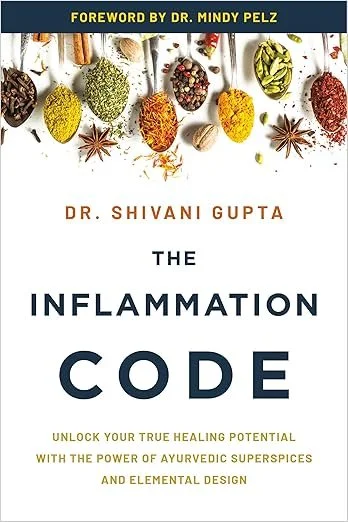
What We Cover
In this episode, we talk about:
What inflammation can look like beyond pain (think: fatigue, brain fog, mood shifts, “why am I so puffy?” energy)
Dr. Gupta’s personal story, and why inflammation became her life’s work
Why chasing symptoms creates a hamster-wheel effect (and how to step off it)
The concept of mental inflammation, and how stress spills into your body
The 6 pillars of an anti-inflammatory life:
circadian rhythm
gut health
diet
self-care
detoxification
stress management
When “healthy habits” actually become inflammatory (yes, even the wellness stuff)
Ayurveda basics: Vata, Pitta, Kapha, and how stress shows up differently for each constitution
Why “sweet” can be supportive in Ayurveda (and what that really means)
Simple daily tools that make a surprising difference (including a copper tongue scraper)
Turmeric + spices: why they matter, how to use them, and how to make it actually doable
The deeper message underneath it all: you are sovereign in your health
Favorite Quotes & Sound Bites
A few moments you’ll want to remember:
“We could instead build a lifestyle that’s preventive.”
“We end up on that hamster wheel of chasing side effects.”
“Your intuition knows the truth.”
“You have your own toolkit for balancing yourself.”
“Disconnect food from feelings for just a moment.”
“Turmeric is the ultimate janitor for your body.”
“You are sovereign in your health.”
“Sleep is when we’re going to clear inflammation.”
Chapters
07:46 Understanding Inflammation: Signs and Symptoms
10:52 The Pile-Up of Inflammatory Issues
13:46 Triage Plan for Inflammation
20:38 Healthy Habits That May Cause Inflammation
24:21 Mental Inflammation: The Stress Connection
29:36 Mindful Practices for Stress Management
31:43 Understanding Your Constitution and Stress Responses
34:05 The Role of Spices in Inflammation Management
35:17 Personalized Dietary Strategies for Each Constitution
40:20 The Power of Turmeric and Other Super Spices
49:13 Practical Tips for Reducing Inflammation
Why This Episode Matters
Because inflammation isn’t just about joints and pain scales.
It can show up as:
waking up tired even after sleep
mood swings, irritability, or that “thin skin” feeling
brain fog, forgetfulness, scattered focus
bloating, puffiness, stubborn weight shifts
skin acting weird, hormones acting weirder
feeling reactive to foods, stress, people, and life in general
And the frustrating part? You can be doing “all the right things” and still feel off.
This episode is your reminder that inflammation is often a pile-up, not a personal failure. Dr. Gupta brings it back to basics in a way that’s simple, realistic, and actually sustainable — because the goal isn’t to become a wellness robot. The goal is to feel like you again.
About Dr. Shivani Gupta
Dr. Shivani is an Ayurvedic practitioner and expert in fusing Eastern and Western practices that help our bodies achieve equilibrium. She completed her Master’s in Ayurvedic Sciences and her PhD on Turmeric. Inflammation is a root cause for many health issues in our lives and we have the power to overcome it. Her passion is teaching at-home remedies to reduce inflammation naturally will help you enjoy more energy, less brain fog, less pain, and ultimately achieve vibrant health! She is also the founder of Fusionary Formulas, an Ayurvedic company that helps people with inflammation and pain.
Social media: @dr.shivanigupta
Links Mentioned In The Show
Dr. Shivani Gupta / The Inflammation Code: www.theinflammationcode.com
Website: https://shivanigupta.com/
Fusionary Formulas: Use Code TANSY15 to get 15% off your entire order!
Reiki-Infused Crystal Essential Oil Rollerbottles
Podcast review promo...Get 15% off a distance energy healing session or a piece of jewelry with a positive review of the show. Email photo of review (after submitted on podcast platform) to info@tansyrodgers.com
Support Beyond The Episode
If this conversation hit home, and you’re craving deeper support (not just ideas, but real integration):
Join the newsletter →
Thanks for listening, friend. If you’ve been feeling inflamed physically, mentally, emotionally, or energetically… I hope this episode gave you language, clarity, and a next step that feels doable. 💜
Transcript
-
Tansy Rodgers (00:13.73)
Welcome back to the energy fix, a podcast dedicated to help you balance your energetic body by diving deep into the sweet world of all things health and spirituality. My name's Tansy and I'm an intuitive crystal Reiki energy healer, energetic nutrition and holistic health practitioner and a crystal jewelry designer. It's time to talk all things energy. Let's dive in. We're continuing our health book series.
And this is a series where I am bringing authors who can translate big health topics into something that you can actually use in your real life. And I am genuinely so excited about today's guest because she is back on the show. And if you've listened to her first episode with me, you already know she has that rare magic blend of grounded science.
ancient wisdom that doesn't feel fluffy or airy. She is just so full of knowledge and wisdom. Dr. Shavani Gupta is an Ayurvedic practitioner and an expert in fusing Eastern and Western practices in a way that helps the body find real equilibrium.
She's completed her master's in Ayurvedic Sciences and her PhD focused on turmeric. Yes, yes, turmeric, the golden spice that you've probably heard so much about, but maybe never really have fully understood beyond, hey, it's good for inflammation, right? She is also the founder of Fusionary Formulas, an Ayurvedic company that's created to support people dealing with inflammation and pain.
And her passion is really teaching practical at-home remedies that reduce inflammation naturally so that you can experience more energy, less brain fog, less pain, and ultimately more vibrant health. And today, she is here to talk about her brand new book that's coming out, The Inflammation Code, which officially launches on February 3rd.
Tansy Rodgers (02:24.618)
I'll have the link to grab your copy down in the show notes that you can order it as soon as it drops or order it if pre-order is available. Now, if you haven't heard her original episode when she was on the show, you can go back and listen to episode number 68. And we're talking all about Ayurveda and inflammation back there as well.
It's one of those episodes that makes your body just go, so that's why it's happening. Like I know during the episode, that was exactly how I felt so many times that she was talking. This conversation is such a powerful continuation. It's more practical, more specific and perfectly timed for anyone who has been feeling inflamed or puffy, tired, achy, foggy.
Really anything like your nervous system and your immune system are in this constant struggle together. In this episode, we talk about inflammation in a way that's clear and empowering. We dig into how inflammation can show up beyond just pain. We talk about how stress and gut health and sleep and hormones, all of these daily choices that we make quietly contribute to this inflammation. And we talk about why
Quick fixes rarely work long term and what it looks like to actually build an anti-inflammatory life that's realistic for your busy schedule. If you've ever wondered why you still feel like you're running on fumes and your body hurts even though you're doing all of these things to take care of yourself, this episode is absolutely for you. All right, here is my conversation with Dr. Shivani Gupta, the author of The Inflammation Code. Let's dive in.
Welcome back to the energy fix, Dr. Shivani. I am so excited to have you back on the show.
Dr. Shivani Gupta (04:18.839)
Thank you, thanks for having me.
So you are here. When you were here before, we talked all about your incredible supplement line. We talked about turmeric. We talked about all of the good stuff when it comes to healing with turmeric. But today we're going to be expanding on that and we're going to be talking about a topic that I feel is so incredibly important.
important is also a really hot topic that I talk a lot about with my own clientele and in the community of who I serve and that is inflammation. Sure. Yes. I am so excited. All right. Well, let's just dive right in. Let's start at the beginning, Dr. Shivani. What cracked open the idea of writing this book, The Inflammation Code, and what did you have to really unlearn from your earlier work?
to write this one and step into this phase.
You know, for me, inflammation has been a problem for my family my whole life. And so growing up, I'd go to India to see my grandparents and my cousins every year. And every time someone would be suffering from the long-term effects of diabetes and inflammation. And so that would crop up as quadruple bypasses being needed or heart attacks or Parkinson's and things like that. And I kept thinking, what is it with my family that we're all so inflamed?
Dr. Shivani Gupta (05:42.924)
We're obese and sedentary. No one wants to exercise in my family. And so much stress happens due to work and business and life that it creates this perfect storm for disease. And I kept thinking, okay, I have to find a way to reverse this for my grandparent generation, my parent generation, and then my generation. And then over the last decade of owning a supplement company based around turmeric and inflammation, I kept seeing that yes, turmeric is very effective. You can totally win at inflammation using the spice.
but we're still chasing the problem with a pill. So taking a pill for a problem, which is a very Western mindset of like, let me just solve it and let me move on. But what I realized is if I don't teach everyone the lifestyle, that preventive Ayurvedic lifestyle, then we're always gonna be reaching for the supplement. When in fact we could instead build a lifestyle into a place that's so preventive, and then we're winning at inflammation just by how we live.
And then when you want to reach for tumor for support, can. Tumor is still wonderful. I take it as my daily preventive. I take it if I get hurt or I need it or I need immune support. I still have a lot of uses for it. But it's not as much because I'm inflamed chronically. I already built the lifestyle to win at that. And so this book, The Inflammation Code, talks about how to build an Ayurvedic lifestyle into place as your foundation and your blueprint.
for how to navigate life according to your elemental design, which is your body constitution based on your primary elements. And then I go over my six pillars, which talk about circadian rhythm, gut health, your diet, self-care, detoxification, and then managing stress and building resilience for stress.
I love that. love that. I love that because I know even in my own work, it's so much about personalization and I love that your book is bringing that. So before we get into the frameworks and all of the nitty gritty of this book and how it's serving, let's just take a few steps back. Let's talk about inflammation specifically. I would love
Tansy Rodgers (07:46.156)
to help you or to have you help the listener really spot what is right in front of them? What are some of the quiet ways that inflammation tends to show up in our lives?
One easy one is when you wake up, how do you feel? Do you feel tired already when you start your day or do you feel ready to go? When you put your feet on the ground, are you feeling fine and ready to hop up and go on with your day or does it take a few minutes? Do your feet hurt? Do your joints hurt? Does it take a couple of minutes because you have aches and you have stiffness? That's a sign of inflammation. Throughout your day, do you fatigue easily or get headaches? When you eat a meal, do you get bloated or have indigestion?
Any of these things can be signs of inflammation. Do you have waking that's really stubborn and you're not winning at it? That can be inflammation. And so a lot of times inflammation is this chronic low grade persistent inflammation in our bodies, wreaking havoc, causing joint pain, causing damage. And we just don't hear the fire alarms that are going off. But we're sitting there saying, gosh, I just don't feel the same. I don't feel like myself. I think this must all be aging.
And someone had coined the term, a professor actually coined the term, Inflammaging. Inflammaging means inflammation meets aging. And all of a you think you're aging, but it's actually inflammation making you feel like you're aging. And so anytime I have that voice come up inside of me, I go, no, stop. That's inflammation. And you know how to win at inflammation. You start with turmeric, then you add in the rest of your super spices. Are you sleeping well? How are you eating? How is your stress? Have you given up or been too busy to do your self-care stuff?
Are you moving in nature? Because is your circadian rhythm off? So I go through my own checklist and then I'm like, yeah, I got off track. I was traveling for a week. Let me just get right back on track to win. And so inflammation in a chronic state sounds like all the symptoms I just said. And we know that acute inflammation is typically like a fever, swelling. That's more obvious in the system. Because chronic inflammation is not obvious, we often ignore it and we wait till we have this
Dr. Shivani Gupta (09:54.754)
big pile up of issues and then we go running to the doctor and we're like something's wrong. And they're like well joint pain let me give you a painkiller. Well high cholesterol let me give you another pill. Well this problem let me give you another pill. And then we end up kind of on that hamster wheel of chasing side effects for different things that we take. Now I'm not saying all Western medicine's bad, those solutions are phenomenal, they work. But could we have prevented that inflammation much earlier in that cycle? And that's my goal for people.
Yeah, and so let's go a little further even into that pile up method because I feel like for many people they may not realize what things may be contributing to this pile up of inflammatory issues being out of control, right? And so let's talk about what that pile up looks like and also if you had maybe, I don't know, 48 hours with somebody, what would be your triage plan to really
that pattern and to help people get back on track.
Sure. So first let's cover what causes inflammation. And it's more things than people might realize. You might think it's food. You might think it's alcohol. And yes, alcohol is inflammatory. And yes, in the food categories we have certain foods that are more inflammatory, like sugar. For some people it's gluten. For some people it's dairy. For some people, well, for all of us, it's processed foods and seed oils and these fake ingredients that the body doesn't know what to do with.
but it could also be things like environmental toxins. And so in the book, I talk about inflammation as anything that comes at the body and the body doesn't know what to do with it, because it's an outside force and the body's like, I don't recognize that. I don't think that's healthy. The body's survival mechanism will kick in and say, I'm going to push that out. I'm going to have a reaction. And that's why we see the body is at war with itself so much. We're having this prevalence of inflammatory issues and we're seeing autoimmune issues. And so
Dr. Shivani Gupta (11:52.942)
When I say environmental toxins, it could be living near a factory of some kind with really harsh chemicals, but it could be your water quality, your air quality, your food quality. Are there a lot of pesticides? Are you consuming a lot of microplastics? Are you drinking out of water bottles that are plastic every day? Could be little things that accumulate and add up. And so we really do look at that as, what are we gonna do here to reduce that? Then we think about viruses, bacteria.
Your pH balance in your body can affect your inflammation. Grilling foods or frying foods, the process by which you cook things can cause inflammation, because you're changing the state of that food into a more carcinogenic or problematic way. And so when we look at it through that lens, it kind of simplifies things. What is one way to reduce inflammation? Reduce your total toxic burden in life, endocrine disruptors. It could be something as simple as changing out within your laundry cabinet or your kitchen cabinet or your...
bathroom cabinets just reduce toxic burden to reduce inflammation. And I like that because that's a kind of one-time homework. If I switch my soap, I just keep switching that soap forever. And then the other is how do we look at our diet and make some shifts to reduce that total inflammatory burden and increase the anti-inflammatory foods or super spices and super foods that help us. And so that's really my thought process there. And then your second question was around how would you triage someone in 48 hours?
I try so hard with my family. My family is the least group, like the group who listens to me the least. I always go to my mom's and I'm like, mom, you have to sleep earlier. You have to do this. So let's say it was an ideal client, because I do have some amazing ideal clients who do listen to everything I say. Sleep is my number one. If you can fix sleep, overnight is when you're going to clear inflammation and clear the lymphatic system. And ancient Ayurveda teaches that on the circadian clock,
10 to 2, the top part of the clock, is what we call Bitta time of day. In the West we pronounce that Pitta. So your Bitta time of day is when the fires come out, the sun is usually highest in the sky at 12 noon, right? And so you imagine those fires come out and help you clear inflammation from 10 to 2. Most people sleep after 10. And so my first homework is move your bedtime up, sleep as close to 10 as possible. And Ayurveda teaches that 10 to 12 on the clock is twice as important as the after
Dr. Shivani Gupta (14:16.428)
midnight sleep that you get. Twice as beneficial. And so really trying to move up that bedtime doesn't have to be every night, but most nights can have a significant impact on you taking out the garbage when it comes to inflammation. And we know that we collect glymphatic waste in the brain. Imagine if you never took out the trash in your brain. You could be collecting pounds of glymphatic waste in your brain throughout the year. And then we wonder, why do I have brain fog? Why can't I think straight? Why can't I remember anything? It's like, well,
Are you taking out the trash at night or are you on social media in bed and kind of bypassing your entire detox process? So sleep is my biggest one. Then I would say align to your circadian clock, which sleep is a piece of, but it would be wake up on time every day at the same time, eat your two to three square meals a day. For some of us, it's three plus a snack, but eating within the correct time windows for your constitution is very important. Then going through and building a rhythm.
According to Ayurveda, wake up and move, eat your meals, do your work, wind down in the evening. We call six to 10 PM, gaffa time of day. It's a time to wind down and settle down. And so many of us in modern day life ramp up. We're like, no, happy hour, dinner, fun, going out. Ayurveda teaches us when the sun sets, you are meant to set and relax and have a sleep hygiene ritual to guarantee that wonderful sleep. So I would start there.
And then I would triage into gut digestifier, then diet, and then self-care, and then I'd keep going down my
A quick pause because if inflammation has been showing up in your body lately, think stiffness and achy joints and lingering soreness, swelling, brain fog, then you're not alone. One of my go-to supports is Turmeric Gold by Fusionary Formulas. It's a blend that's designed to support a healthy inflammatory response and I love it because it fits so easily into real life. It is simple, it is consistent, and the products are
Tansy Rodgers (16:21.296)
just so reliable. If you want to try it you can use my code TANZ15 for 15 % off. I'll have the link in the show notes so that you can grab it easily. Tumor Gold by Fusionary Formulas is one of my go-tos and it is the one that I find to be so supportive when I'm really feeling inflamed. Again, jump down into the show notes, click the link and use code TANZ15 to get 15 % off
your entire order. Alright, let's jump back into this episode.
You basically just described my perfect day. So this is so interesting. So in Ayurveda, I am a Pitta, okay? And so Pitta, but I also know that I have very high Kapha as well. And so this is so interesting because...
With the pit to time frame, I have said over and over and over from 10 to two is my personal, this is before you said anything, it is my fire time. I feel most alive from 10 to two. I could do the most incredible, deep, cognitive, brainstorming, creative work between that time. And once I hit the evening, I'm done.
I'm done. And so this is so fascinating because I don't know if that's because I'm all that is already my constitution and I just feel it more intensely or you know if that is just me in my natural rhythm.
Dr. Shivani Gupta (17:56.066)
Sure. I mean, if your primary constitution is Bitta and your second constitution is Guffa, your job is to also honor your Guffa aspects. And once Guffa gets home for the day and sits down on the couch, Guffa does not get up again. It's like Mother Earth sat down and we're not going to get her up off the couch. And so it's tough because sometimes we have this modern day programming around, you need to hustle more, you need to do more, you need a side hustle. And it's like that goes completely against Guffa nature.
Guffa's not meant to do that. Guffa's meant to chill, relax, and then be their most loving self again the next day and serve and love. So we have to honor the energetics and the elements of who we are and not constantly break it and defy it and then wonder why we don't feel our best.
Yeah. And so just as like a little side note here before we go on, because I have more questions around this, little side note for those who maybe aren't sure of what their constitution is in your book, it has a personality quiz. that does that help the listener learn what their constitution is or do you have other resources that you can send them to in case they're curious?
Yes, the book has it and on my website at drshivani.com the quiz is live and ready. It's called the Elemental Design Quiz. And when you take it, you immediately get an answer and a video explaining what your primary constitution is so you can see how it resonates with your life.
cool, cool. All right, so kind coming back to this whole concept of inflammation, we talked about a lot of the more well-known, quote unquote, more well-known issues of inflammation and what may be affecting the body, but I want to take it even a step deeper. Let's talk about the healthy habits because I know personally in my life, I over like...
Tansy Rodgers (19:51.458)
you know, over the years of being in this holistic health world and being obsessed with doing all the things, there are so many healthy habits that I tried to implement that either have been the rage or, you know, practitioners have told me to do or whatever it is. And I found they actually hurt my body more.
And so can we talk about where do you see these healthy choices really stoking inflammation in the body and what might be something that we can either swap it out or even just gently nudge ourselves towards to be able to decrease the inflammation from some of these healthier things that we may be doing.
Sure, so if you think of inflammation as your body's response to anything that doesn't belong and your body's response to you being out of alignment, then it kind of makes it easier to navigate what is the counterbalance to it. So for example, if I have a day that's super stressful and I know I'm gonna be on camera five hours straight, then my counter pose to that is I will definitely walk in nature
I will connect to my family. I'm gonna have extra adaptogenic teas with, you know, Shatavari or Ashwagandha in them to calm my nervous system down from that intensity. And so in the same way, when we look at inflammation, a lot of times the issues we're having is we're so intense in certain areas of our life. Maybe it's our diet. Maybe we're going real extreme in the diet into carnivore or keto 24 seven or vegan or.
Vegetarian or whatever it is. I happen to be vegetarian. So whatever it is you're choosing you might be going extreme inside of that category and the body's like hey the middle road is what actually works here. I need nourishment. I need diversity. I need to live according to my circadian diet. I need to live according to my constitution and if we're constantly breaking those rules with ourselves, that's what causes inflammation. And so it's easy to kind of sense in a way because anytime you go down a road of extremism
Dr. Shivani Gupta (22:06.188)
Your body might say, you know what, I don't like this. What are you doing? Why are you doing this? We should listen to our intuition. Ayurveda says your intuition knows the truth. I'm a practitioner who's just here to help show you what your intuition already knows and help you hone and train that intuition to give you the best answers going forward. So you don't need me on this journey with you. You actually just need yourself. And so anytime we go down those extremes, it's just about self-correcting back onto our own main path. It's not about
any of the extremes that we're talking about nowadays. Nowadays when you look online, it's like microplastics will kill you. And if you go carnivore, all your life problems are solved. And if you just take some methylene blue, everything else will be solved that wasn't solved by carnivore. And it's like, I'm a woman, my body lives on cycles. My body actually needs me to be really nice to it, especially as I age. And the more extreme stuff I try, cause I do try all of it. I bought methylene blue, I'll try everything.
My body's always like, what are you doing and why? No. And I always laugh because I'm like, but I thought it would be great. And my body's like, no, no, no. Tumoric, ginger, good sleep, circadian, moving in nature and the ancient self care tools. You've got this. Like, please don't add anything on the pile up. And so that's my word of encouragement to your listener today is you have the power within you to heal and balance yourself at all times. Think of inflammation as friction.
Anytime we have friction in the system, the body's gonna react and say, hey, I need to calm that down. And so what if you built a lifestyle that was constantly calming that friction down and then coming from that place of alignment, of body, mind and spirit and alignment, and thus the body always had the resilience and tools on board to cool down that inflammation in different spots and then give you that health and vibrancy that you want.
All right, Dr. Shabani, this I feel is a question that goes along with the inflammation concern that becomes a topic very hot onto conversations in my own world and my own practice. Mental stress. Yeah.
Tansy Rodgers (24:21.288)
What about the mental stress that can come in and cause the body to become inflamed? Can we talk about that and what that looks like?
For sure. So when I was writing the book, I wrote all about inflammation. All these are the causes, all these are the solutions. Here's the lifestyle, here's how to detox seasonally with Ayurveda. This will help you reduce inflammation. It's like an oil change every year, then we don't have accumulation. I had so much fun writing the book. And then finally, I was thinking, I get all my best ideas in the shower, probably because I'm a Fittha, and anytime you put me in water, my ideas flow in. And I was standing there and I was like, how do I explain to people that we can...
actually go the other way. You know how you have orthorexia where you overwork out? I feel like in the health and wellness world right now, it's creating a lot more orthorexia where we're getting so overly obsessive around health and wellness, adding more and more on the plate and then being stressed out about how we're not doing enough for our health. And I thought we're gonna create inflammation just by being the way we are right now.
and dealing with the level of stress modern day life provides naturally. There's a 24 hour news cycle. We're so interconnected. There's like AI taking over. There's governments doing all sorts of crazy stuff. The planet's going in the weirdest direction possible. And we usually feel that way. I remember pre 2020, we're like, the world's gonna be amazing. And then everything went upside down. And ever since then, we kind of have this uneven footing where
The consciousness and the collective has a lot going on in it. And we're always like, how do I just feel good? How do I feel stable? How can I know everything will be fine? And we know life has a lot of change and ups and downs. There's no perfect. But I think what's interesting is in Ayurveda, we talk about how do you stay most balanced and resilient for you? And so the term that came to mind for me was mental inflammation. I wanted to teach that there's this mental stress, mental load, overwhelm.
Dr. Shivani Gupta (26:24.718)
that I called mental inflammation as a new term we can all use to understand how our mental inflammation is causing the physical inflammation that we're dealing with. And so you could do all the right things in your physical space and do everything I say. But if you still hold a very high level of stress, you will still cause inflammation and disease in the end. And so building stress resilience, I think is as important as everything else that I teach.
And so I do that through what works for my constitution. As a Bitta, I need to keep my fires cool, calm, and collected. So I walk in nature twice as much as I would recommend for most people. Why? Because that's the one thing that soothes me down. In Ayurveda, we taught meditation every morning. We know meditation creates this quiet pool of stress resilience. We taught pranayam. Pranayam is deep breathing. We know that deep breathing will take you out of a stressed state.
out of fight or flight and into your parasympathetic. We know breath work can create vagus nerve toning. So there's a lot of the self-care practices and rituals that are part of a great ritual, morning habit that we can build and those can support us at winning an inflammation. And then we can also understand that what is gonna support us best. For me, I have a very active mind. And so the more I can walk in nature or listen to yoga music or breathe, the better off I am.
Every weekend I commit to yoga because that's another building of that pool of stress resilience. So I think it's about taking what Ayurveda offers us, practice it, figure out what works best for us and gives us the most relief from the stress we all will be carrying it throughout our lives. And then thus we don't let stress tip us over when it comes to the bucket. There's a lot of things that can cause inflammation in the system. But the problem is sometimes stress is the
hair that broke the camel's back and takes us over and spilling over and then we've got a crisis of inflammation. And so my goal for everyone is let's keep emptying the bucket, bringing it down. Let's use adaptogenic herbs. Let's use self-care practices. Let's use circadian rhythm. Circadian alignment alone will reduce stress inside of the system. And then one of my self-care habits that I love, that I teach, that's my favorite, it's called tea time is me time. So I pause five times a day.
Dr. Shivani Gupta (28:48.172)
and I sip on a delicious cup of warm tea and I have a tea line built into my company and I use adaptogenic teas to calm my nervous system and to take a minute to tune in. And so I always tune in and ask myself, how are you doing today? What do you need to do to change today and make it better? What do you need to handle this week for this week to feel better? And my own intuition gives me powerful answers. Like you need to cancel that. You need to change that.
You need to adjust this and you haven't eaten enough today and you're dehydrated. And I'm like, okay, got it, got it. And so your own body wants to help you. Your own intuition has all the answers. It's just about giving yourself a mindful moment or an anchor moment to tune into that and get that wisdom. That alone can help you win at the stress that causes inflammation.
Yeah, I love that. And so for those who maybe don't have the ability to drink the tea or to is I just want to emphasize it's really about any mindful moment, whatever that could be. Maybe that is putting your hands over your heart or your hand over a heart and your hand over your belly and just tuning into the body. And so would you say that this is the way that you track to see where you're at? Or are there other ways that you can track to see where your mental stress load is?
really sitting, especially when life gets chaotic and maybe we're not as in tuned as we need to be and all of a sudden the train's running off the tracks, right? Like are there ways that you can track in between?
Yeah, I mean for me sleep is a good indicator. If my sleep is off, if I'm waking up in the middle of the night with thoughts and I'm waking up early in the morning with thoughts and I can't sleep after that, that's my first sign that I am overstressed because my mind is churning on them and it's affecting sleep. So that's always my first sign. My second one is if I am running around and I can't and I feel overwhelmed constantly, then I'm like, what's going on?
Dr. Shivani Gupta (30:47.778)
Why is the plate too full? Where do we need to readdress and reassess things? Like 2025 for me was a year of mold in the house. And so it was like rip apart the entire house, fix it so all my free time went to mold and I had nightmares about it. So it was just, it was like, okay, I understand that this is a stressor. How do I prevent the stressor from taking a physical impact? Cause I don't want that physical impact. I already have to detox from the mold. Let's not cause new problems on top of existing.
And so my homework to myself was every day check in with yourself, make a cup of tea, just heat some water, throw any tea bag in it and use that as your time. Or go walk in nature, breathe in nature. Whenever we breathe in nature, what we're doing is we're showing the body a moment, just a moment to tune into self and calm down. And we're aligning to our circadian clock, which is going to only improve our sleep. So to me, it's like, how do you look at what's happening?
How do you compartmentalize it into, okay, I'm not gonna let this affect my health. I know that I'm stressed, but how am I gonna look at it and say, okay, it's showing up. I mean, we're all so different. So based on our constitution, it could show up differently for us. For me as a Bitta, I get angry. I get frustrated. I react with burnout. That's my reaction. So the minute I feel burnt out, I'm like, okay, you're feeling burnt out, but you love what you do. So what's happening?
it's just too much on the plate. Okay. Are you delegating? You have a team. Are you delegating? Are you sleeping enough? Are you eating enough? You're a bit though. You have to fuel. If you're going to starve all day, cause you're going to sit on camera all day and not keep your snacks and your hydration, you know you're going to burn out. So let's keep the snacks and hydration here so you can stay on your track. And if you're guffa, your tendency when you're inflamed is going to be feeling depressed and low. You're going to just stop.
That's like the reaction of earth is stop and just wait and not make decisions. So if you're in that place as a kaffir and you're just like hiding under the covers, how do you get your energy moving in the morning and start to win an inflammation? So that's not the reaction is that stuckness. And if you're a bitha, could be anxious with insomnia. That's the reaction of vata when imbalanced. And so for vata, the homework is, I don't feel good. Let me go put my feet in the grass. Let me eat a.
Dr. Shivani Gupta (33:07.018)
a tea with some heavy nut milks or anything to weigh me down. Let me eat an avocado and get grounded. Let me just ground my energy and everything will shift. So that's where Ayurveda is really cool is we are personalizing to the constitution in front of us and saying you have your, we say you have your own toolkit for balancing yourself. So I can't say everyone should walk in nature. I'm just a vipa and that's my favorite easy tool. It's more where do we help you balance best for you?
And for all the other pits is out there, I will say yes. Yes. Yes to the nature thing, especially that is one of my go tos. I love that. Yeah. All right. So let's come back to those frameworks. Now. Let's talk about the elemental designs. Let's talk about some of these details. What are the elements and how do they map to specific inflammation pathways? Okay. A quick break to really dive into and share a tool that's been supporting
me a lot lately and that is my Crystal Essential Oil Roller Bottles. They're made for those moments when you don't need a whole routine, you just need a little bit of a shift and you need that shift quick. A quick reset that you can do in the middle of your day when your brain is loud, your body's feeling tense, or you're heading into something that you know is going to pull in your energy.
Maybe it's before a meeting, before walking into a crowded store, when you're in your car, maybe right before bed, or when you're ready to transition from doing everything for everyone and being back into your own body. They're one of my favorite small but mighty supports because they help you create a consistent cue for your nervous system. In these products, I am using high-grade therapeutic essential oils and organic fractionated coconut.
oil so you know that you are getting high quality whenever you use any of these Crystal Essential Oil roller bottles. If you want to shop the roller bottles, the link is in the show notes or you can go right over to beucrystals.com. I can't wait to see what you find!
Dr. Shivani Gupta (35:17.678)
for sure. So we teach about three different constitutions. The five elements are air, ether, fire, earth, and water. And so those three constitutions in elemental design are vata, pitta, and kapha. And so a vata person who's air and ether, when it comes to their inflammation, tends to be a lot of gut issues. They tend to have constipation, tend to have slowness in the gut because of their dryness. And so the homework we have for vata is more hydration,
more oiliation, they don't actually need help moving because Vata is always in motion, but that dryness needs to be addressed. Once the system is moving and moving well, we know gut health is tied to our inflammation and they get that support. We also help Vata with sleep. So I develop sleep teas, sleep gummies. I believe in using whatever tool it takes to get good sleep, because sleep is when we're going to clear inflammation. And so I always support with how do we get you to move enough in your day? Sometimes you need to walk more and exercise more.
and create enough sleep pressure to get good sleep. Sometimes we're staying indoors too much and we're just not aligning to our circadian light enough to get that good sleep. Then with bitthas, different conversation. Bitthas love to eat, bitthas get hangry, and bitthas love everything we're not supposed to eat. So we love fried, oily, spicy foods. And so bitthas tend to run inflamed because we're just like eating and eating our feelings. And so the homework for a bittha is okay.
Let's disconnect food from feelings for just a moment. And let's remember that anything sweet that you consume will actually calm down anxiety. And that applies to all three constitutions. So you could be vatapita or kaffa. Sweet calms down anxiety. And as a society, we're pretty stressed out right now. And you could play this podcast anytime within a decade, and that's still true. We're pretty stressed at any given moment.
And because of that, that's why so many people say I'm a chocoholic, I'm a sugaraholic, I just can't handle not eating my sugar, I need it. And it's like, yes, you're using that as your form of cooling down stress and anxiety in your system. That's okay. Let's just reach for healthier versions. Can we get it through honey? Can we get it through, rice has a cooling effect. Can we get it through tea? Like there's a lot of different ways. Cinnamon has a sweet effect. So it's like, what spice can you reach for that...
Dr. Shivani Gupta (37:39.886)
calms that feeling down inside of you and what food can you reach for? I reach for coconut water. I reach for anything like that. That's why we are very carb heavy when we're stressed is we want that cooling effect on inside the body. And so for Bitha's the homework is coconut water, hydration, cooling foods, not heating foods and that calms our system down. And then for Kaffa, the homework is when they're inflamed is get their energy moving. Get that.
metabolism moving, get that system moving, get that energy body moving, because they can end up really depressed and low and stuck, and we want to get that gut digestifier back online. So those are kind of the subtle approaches we use when we find someone needing help, is we shift everything to back.
That's so interesting. never realized, especially from the Ayurvedic standpoint perspective, I never realized that carbs were a cooling effect and that was why we crave them so much, regardless of what your constitution is. That's interesting.
Yeah, rice has a cooling effect on the inside. Weeds can do that as well. So you see us reaching for anything that's sweet because we want that fire to cool down some.
Wow. Okay. All right. And so let's kind of add in the whole concept of spices here, because you are big on turmeric. You're big on spices in general. Do the different constitutions demand different spices or different timing or dosages or whatever it may be? Is there different ways to work with these spices depending on your constitution as well? To help with inflammation, I mean.
Dr. Shivani Gupta (39:21.08)
Yeah, I mean there is different ways to work with the spices based on the goals that you have. So for example, a vattha person. If they're constipated, they would reach for aloe vera juice first thing in the morning. That would help with constipation. Any warm water would help them as well. So we don't look at it as each constitution should use these spices year round. We look at super spices as medicinal tools to be added and subtracted on any given day based on what you need.
In modern day life, we know for a fact we're so inflamed that it makes sense to bring in these super spices as the natural alternative to other stuff that people are using for inflammation. Nowadays, people are using all sorts of NSAIDs and things every single day because they have joint pain. And so that's where using a tumor supplement can be really powerful because you're you're interchanging something. You're saying, don't take that instead of use something natural that's healing on so many levels. That's going to address all the inflammatory markers.
and heal this holistically while supporting other things. And so it really kind of comes down to the mindset. In my case, as a Bitta, I use all sorts of spices because they all have profound benefits. So I want my coriander, which is a heavy metal detoxer. I love fennel because it helps with bloat and digestive issues. That's true for all three doshas. I use ginger regularly. It ignites digestive fire and supports better digestion. I love cinnamon on top of
I don't eat ice cream and sweets, but if I did, cinnamon helps with blood sugar regulation and can turn things sweet. So if you want to use it with yogurt or anything like that, you can. I love eating my fruits and berries, but in IRV that we teach do it separate from any meal because of how fast it digests in the system. I use that a lot. So yeah, I mean, I think of ginger as universally good for all of us and I love ginger lemon tea. Can it be too heating as a bit that person? Yes. So sometimes I have to be careful with it. It can cause like,
heartburn and indigestion and issues because it's like too much and when people say they do turmeric ginger shots I'm like how do you do that? I physically cannot do that. That's like drinking fire and then I'm gonna have pain for like a long time after. So I do believe in turmeric as a daily solution. I make a turmeric supplement, but I also believe in cycling on and off of that as well because any given season I'm a bit that so I need to cool things down more in the summer. I don't need to use it as much in the summer, but I might use it more in winter and all the other months.
Dr. Shivani Gupta (41:48.546)
So I believe in really building a cyclical life around your circadian rhythm with an understanding of your elemental design. And if you're doing great, you're great. And if you're inflamed, yes, let's reach for these powerful solutions.
Yeah. my gosh. I love ginger so much, Dr. Shabani. I love it, but I cannot drink ginger tea. It gives me heartburn so bad and then I'm suffering. interesting. And so with your book, does your book talk about some of these details of the cycling and trying to understand what your cycling may look like for you?
For sure. That's why I had to put it in a book, because then you have the space to really go detail by detail, person by person, constitution by constitution. It's so hard in a podcast because you don't have quite enough time to give like the deeper lecture on these things. So yeah, in the book I teach a lot about elemental design and then I customize for each design across each habit that I teach.
Yeah, interesting. All right, so staying on these spices, when does kitchen spices beat extracts and supplements and vice versa? Because I feel like, for example,
I know many people who try to add in turmeric into their everyday cooking, into their everyday life, and I think that's amazing, but a lot of people may not be getting enough, number one. Number two, they may not be adding pepper in so that it is being absorbed the way that it's supposed to. Can you talk a little bit about some of these details so we understand is kitchen spices, kitchen tools like that enough or do we need to have some of the supplementation added in as well?
Tansy Rodgers (43:42.864)
you
For sure. So when it comes to Ayurveda, we loved using spices in their whole form or ground form. So kitchen culinary spices are what we use in our Ayurvedic cooking or Indian cooking every single day. So in my household, we use cumin seeds. We take them and we use them in whole form, put them in oil and butter, let them heat up. And then any vegetable, any lentil we're going to cook happens right on top of that. Or coriander. We buy whole coriander seeds, grind them every
few weeks and then use that in all the cooking. Paprika, chili powder, we take lemon powder, powdered version of mango powder actually, which is more acidic than to use it in the cooking. We use fresh lemon, we can use ginger powder, whole fennel seeds, mustard seeds. There's a lot of spices we use as kitchen spices. Now in modern day science, we've done a lot of studies on turmeric. There's a lot of interest in turmeric because they found in India
lower prevalence of Alzheimer's and they were like what is it it must be the curry let's go study it and so we have a lot of science now and that's why I did a whole PhD on it I was very curious about this one spice in turmeric we know that it affects all these inflammatory markers NF kappa B TNF alpha interleukin 6 it affects a lot of the master switches of inflammation that downstream then helps it affect the other switches of inflammation what's interesting is
Tumoric is anti-inflammatory, antioxidant, antiviral, antibacterial, antifungal, anti-H. pylori, anti-candida. It supports a healthy gut lining. It kicks out cells that don't belong in the body and keeps all the good ones, which I love that, leaving the good in place. So it's this ultimate janitor, cleans out zombie cells, senolytic cells, malignant cells, whatever's bad inside of us, it kicks it out. And so when it comes to tumoric,
Dr. Shivani Gupta (45:35.882)
Unfortunately, a lot of people are using it in ways where they're not getting enough. When you take that raw turmeric and you juice it or throw it a protein shake, does it have benefits? Yeah, it's the original plant, but it's not at enough concentration. Then you dry it into the kitchen culinary spice. And yes, that is a concentrated version of turmeric. Using it with black pepper or a healthy fat will increase its absorption in the body. So I do encourage everyone use your turmeric.
but eat it with black pepper or healthy fat and get the benefits. No skinny lattes and all these ideas. Really get that fat in there. Because then it'll cross the blood brain barrier, the black pepper increases the absorption 2000%, so you're getting tremendous benefits. Now, the problem is we in modern day society are pretty inflamed because all of life is pretty inflammatory. We're having a toxic burden, a stress burden, an oxidation burden that's unprecedented.
And that's why we're having so many struggles with our health. We don't feel good. And so that's where when you take the entire tumor plant, only three to 5 % of it is the curcuminoids. And that's what we've studied and know is the most effective at reducing inflammation in our bodies. And so that's why when I studied it, I was like, hey, so we need the three to 5%. Why aren't all the tumor supplements just giving us what we want? We should all be winning at inflammation. Well, the problem is extracting that in the best way at the highest potency.
is an expensive process. And so that's when post-PhD people were like, well, which tumor should I buy? And I couldn't find one that I trusted. And so I went out and found a supplier that extracts at the 97 to 98 % great range and they extract mimicking mother nature. So those proportion of curcuminoids is still reflecting what was in that original plant. And so once I built my formula, I put it in the hands of orthopedics because I wanted to prove without a doubt.
that it could be as effective as the other things that doctors are giving us for our pain and inflammation. And that's where I got resounding testimonials was, wow, this really works. And so my message to everyone is when you're buying a tumor supplement, don't buy one that just says curcuma longa or tumor root extract. You want it to say curcumin standardized to 95%. You want to buy it from a company who does third party testing pre, mid and post production.
Dr. Shivani Gupta (47:55.55)
Right in that pre-testing, we're checking for lead, heavy metals, microbes, all those things. You want to know that it's a really clean supplement, which is true for all supplements that you take, but it's important to make sure that you're getting that when you're gonna take a supplement. And then you want that efficacy. If you're taking a tumor and you don't feel anything, it's time to switch. Because I hear that all the time. I take my tumor, I don't feel anything. Like, well, you should be feeling something and then you can go into maintenance mode with it.
Yeah. All right, Dr. Shrani, I'm going to edit this part out, but I just want to make sure, timing-wise, what time is it there for you? Okay, that's what I wanted to make sure, because I was like, we're getting close. All right, so we're going to start to wrap this up then. Okay, cool. I'm sorry, let me just... 42, edit. Okay, cool. All right.
So I have 12 more minutes.
Tansy Rodgers (48:52.078)
Okay.
Alright, so Dr. Shabani, as we start to wrap this up and we start to move into finding out where we can get this book and we can get more information, I want to just talk about some practical suggestions, practical things, other than buying the book, of course, when it comes out.
What are some things that you can start doing right now to be able to start to shift some of this inflammation, to be able to really tune into your own elemental design and be able to make some progress moving forward?
You know, one of my favorite ways is using a copper tongue scraper. In Ayurveda, we teach that a copper tongue scraper and scraping the tongue gently seven to 14 times every morning is a great way to ignite the digestive fire to clear what we call ama or toxins out of our system. That toxin residue that's clogging up our lymphatic system is part of the problem when we talk about why the body is struggling so much.
And so I love copper tongue scraper as a simple habit to get the system moving, get the body ready for the day, and gently detox our body so that as we go over time, we've gently reduced all that toxin burden in the system.
Tansy Rodgers (50:09.591)
Mm, yeah, that's a great idea. And so why copper though? Why copper in particular?
Ayurveda loves copper. Copper is an anti-microbial metal. And so it's interesting in ancient Ayurveda, our copper tongue scraper exists. We have water cups that are lined with copper. And so another habit we teach is put water by your bedside at night in a copper-lined cup, and then in the morning, drink it, and it's remineralizing. And nowadays we know copper has a lot of benefits. So we have simple habits like that, but copper is anti-microbial.
Yeah, one question I do have with that though, if that is done too often, could that be a potential of throwing off the copper-zinc balance?
Yes, yes. So it's interesting. I tested a long time ago. was like my teens before I even had this habit of being high copper. And so you can also use a steel tongue scraper. There's silver tongue scrapers. You don't have to use copper.
Okay, yeah, yeah, because I know, like, I love using copper for so many things, but I'm like, is this going to throw off my balance? Yeah, okay.
Dr. Shivani Gupta (51:12.878)
You have to watch out for that. You have to have that awareness.
All right, well, before we find out where people can get into your world and can find your book, let's just do a few rapid fire questions, just quick, fun, off the top of the head questions. And I'm curious to see where you go with them. Are you ready? I'm ready. All right, Dr. Shabani, number one, what is the spice that you'd sneak into every airport breakfast if you could and why?
it would be turmeric. I'm addicted to turmeric. I'm the biggest super fan of turmeric. And I think it's the most powerful antiviral antibacterial support. So when I travel, turmeric is my number one non-negotiable that I do pre, mid, and post travel just to ensure that I don't catch anything when I travel.
Why am I not surprised you said turmeric? I'm not surprised at all. All right, number two. What is one healthy habit that you quietly retired because it started to spike inflammation?
Dr. Shivani Gupta (52:18.702)
That's a hard question. Okay, I would say that in my diet, I tend to be too strict. I have always been pretty health obsessed. And so I can get really granular and really narrow in my diet. It'll be like, I eat this salad, I eat three eggs, I eat this, and I'll live off of that for months. And so my biggest health shift with that is I eat in a more circadian manner now.
I eat more fresh, I eat more raw, and I live less rigidly on diet purely so I can bring in variety and circadian variety back.
Mmm, yeah, I love that. All right, last question. This one may be a little challenging, possibly. If your element had a soundtrack to it, what is one song that you would put on repeat? And what would it be telling you to do next?
Oh my gosh, I'm not a big music person. Like I listen to music, but I never know the names of any of the songs. So I listened to Coldplay 24 7. It's like my favorite band. Um, and I would say Coldplay has a song that sounds like a party. I can't remember which one. It might be Viva La Vida, but it's like a crazy loud party of fun. And I would say that as a pitta, when I'm in total alignment,
My energy is like that level of awesome, fun, let's do it, let's impact the whole planet. Everything is possible. And I love that feeling. That feeling to me is like, okay, we have fires on on all cylinders. This is amazing. So I would say it's probably Viva La Vida by Coldplay.
Tansy Rodgers (54:02.71)
love it. And isn't it ironic that it's Coldplay where you might as a pitah need a little bit more cooling in your life? That's pretty funny.
So I listen to like clocks. I listen to everything by Coldplay just to keep myself calm and focused most of the time.
Shivani, where can people find you? How can they get into your world? And where can they get their hands on your book?
For sure. So the book is at the inflammation code.com. My website is my name, Shivani Gupta.com. S H I V A N I G U P T A. I'm at doctor.shivanigupta on Instagram and I'm always on Instagram. So feel free to reach out. And that's my name on all social channels. And then my supplement company with Ayurvedic teas and herbs is called a fusionary formulas. F U S I O N A R Y. And I made the code TANZI15.
which will give your listeners 15 % off.
Tansy Rodgers (55:00.276)
awesome. And as always, all of those links will be down in the show notes. So make sure you jump on down there and get into Dr. Shabani's world. Thank you so much for being here again. You are just a light. You are a joy. I would love to know, are there any last words that you want to lay on the hearts of the listeners for today?
Absolutely. You are sovereign in your health. You have the opportunity to create such sovereignty and freedom and to up level your health each and every day. And it comes down to the most simple practices. A cup of tea, a walk in nature, a few moments of deep breathing, listening to a great song and moving your body, reaching into your spice cabinet for another delicious spice to add into your day.
So take those moments for yourself and build the health and vitality that you deserve.
Thank you so much for being here today. Thank you so much for sharing your passion and your joy. I can't wait to read your book and I can't wait to see more of what you do. Thank you.
Thank you, thanks for having me.
Tansy Rodgers (56:10.536)
What an incredible episode that was.
I want you to take a moment and just tune in to your body after that conversation and tune into what might have landed just perfectly for you. For a lot of us, the shift isn't to find the perfect protocol. It's learning how to stop living in constant override. It's understanding that your symptoms aren't a personality flaw. They're just merely data for you to work with. If you want to carry this episode with you, here are three questions to sit with
this week. Number one, where am I living in low-grade stress so consistently that my body has started treating it like normal? Number two, what's one anti-inflammatory choice that I can make that feels supportive? Not pushing, but supportive so it's actually sustainable.
And number three, if my body could text me one honest sentence about what it means right now, what would it say?
Dr. Shavani's new book, The Inflammation Code, launches on February 3rd, and I'll have the link waiting for you down in the show notes so that you can easily grab your copy. If this episode helped you today, share it with a friend who's been dealing with inflammation, chronic stress, pain, gut stuff, or whatever it is that is making them feel off. And if you've got an extra minute, leave a review. Leave a review because that really helps people to see this show
Tansy Rodgers (57:45.79)
and to get it into their hands. Thank you for listening. Thank you for caring about your health in a world that makes it weirdly hard to do that. And thank you for being willing to choose support over self-blame. And until next time, keep spreading that beautiful energy you were born to share.
